
Learn Short-Term Investing From a Pastor, With a Plan That Honors Your Faith
A guided options income plan for Christians who want steady, realistic income growth—without gambling, hype, or endless screen time.

Trusted by pastors, missionaries, and church leaders worldwide
If You Love Jesus and Also Want More Income… You’re Not Crazy
You’ve given your life to ministry and serving others. You live modestly. You trust God to provide. But you also feel the weight of retirement, college, and future expenses, and you wonder if learning short‑term investing is wise, or if it will pull your heart in the wrong direction.
This is probably for you if...
You’ve dabbled in investing or trading but never found a plan you trust.
Some months you’re up, then you give it all back, and your balance trends sideways or down.
You want more income, but not at the cost of your peace, your integrity, or your calling.
A Guided Income Plan Built on Biblical Wisdom, Designed for Steady Income
This membership helps faith‑driven traders pursue consistent monthly income over time by combining four biblical guardrails, a simple market lens, defined‑risk options spreads, and a fixed‑ratio compounding plan.
Faith-Based Guardrails
Four principles from Proverbs shape every decision: risk comes first, discipline is non‑negotiable, trade the long view, and never treat trading as something you can simply copy.
Defined-Risk Strategies
Every trade uses simple spread structures with a clearly defined maximum loss before you ever enter. If the risk isn’t clear, the trade doesn’t happen.
A Clear Compounding Plan
Position size grows only after realized profits justify it, using a fixed‑ratio approach that favors steady progress over emotional swings.
How the System Works
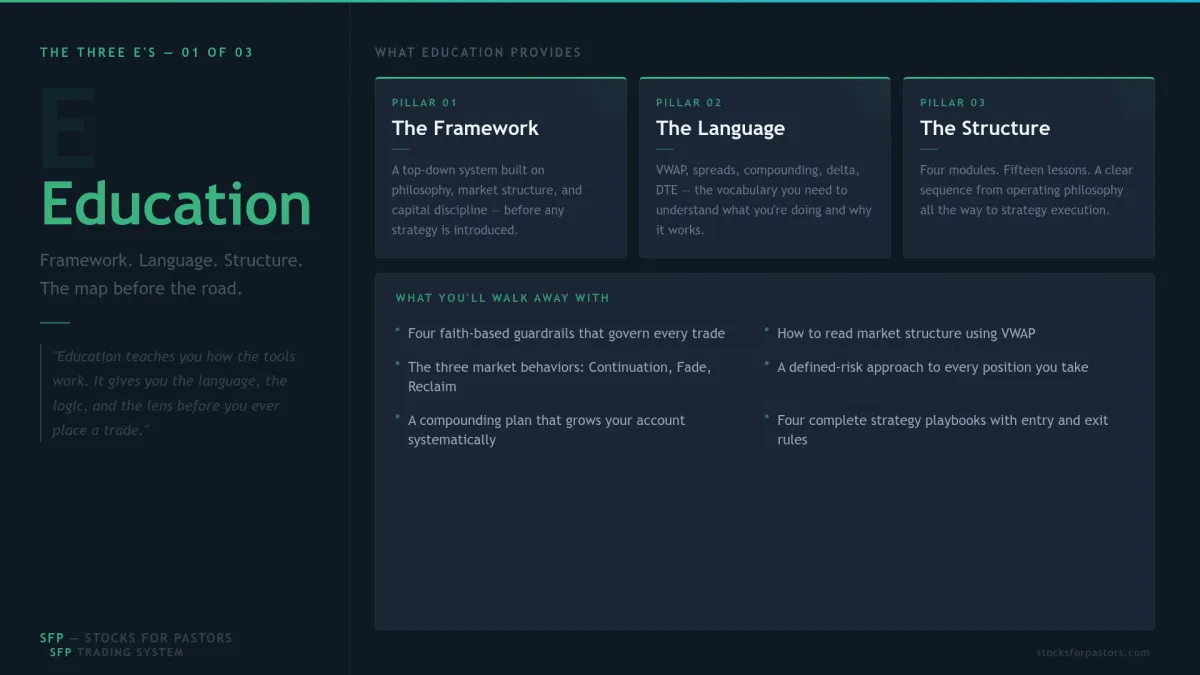
Step 1: Get the Map
Short, focused lessons give you the framework, language, and structure: faith‑based principles, VWAP market lens, risk rules, and strategy playbooks, so you’re not guessing or piecing together random strategies.
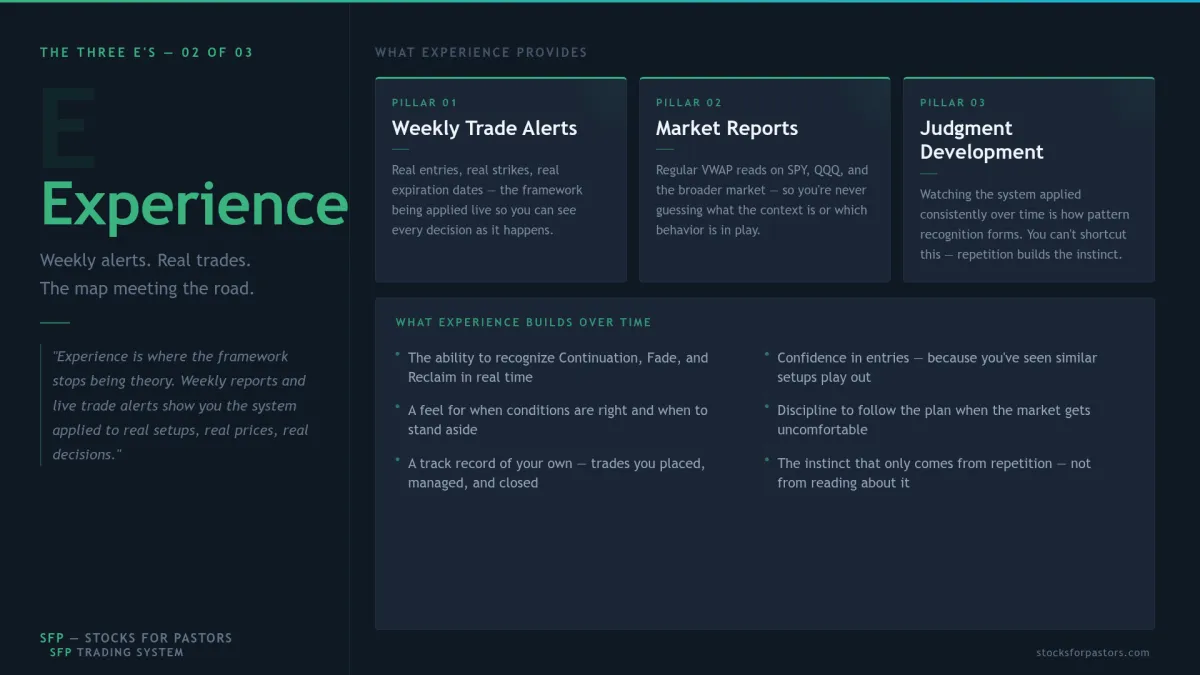
Step 2: See Real Trades
Weekly reports and trade alerts show you the exact setups, entries, and exits, with risk defined in dollars, so the map meets real trades so you can see how those principles look in real trades.
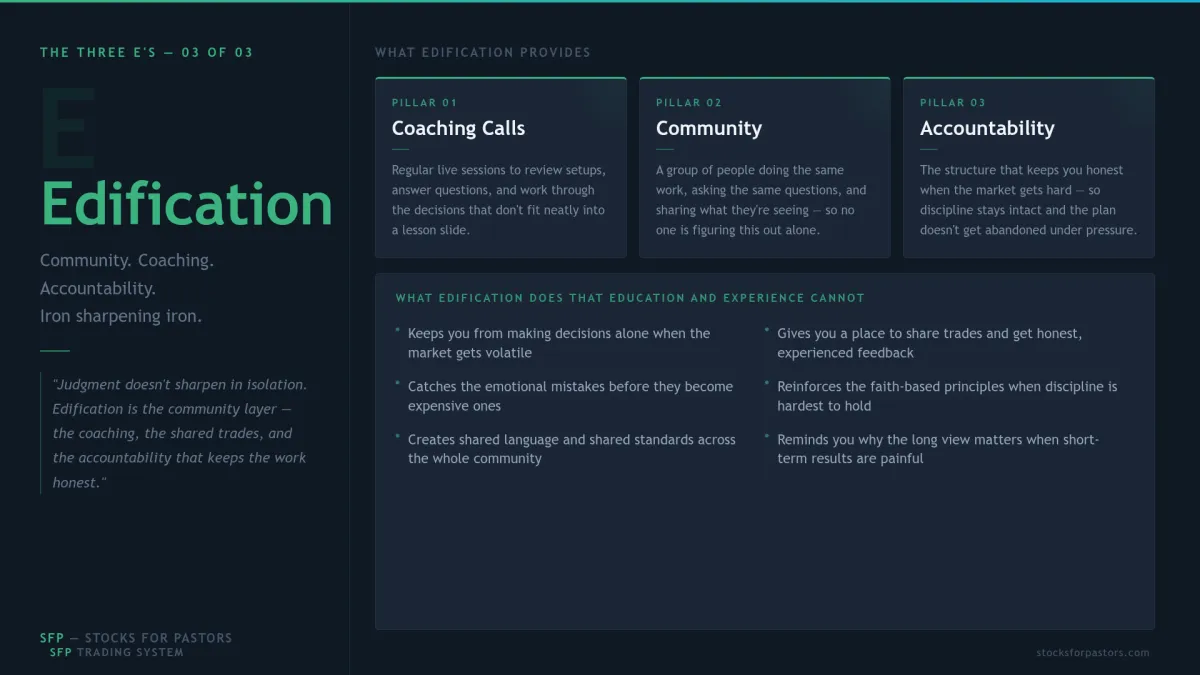
Step 3: Grow in Community
Live coaching calls and a like‑minded community help you stay disciplined, process emotions, and keep your trading aligned with your faith so discipline and peace can grow alongside your skill.
Read Our Latest Blogs
Lorem ipsum dolor sit amet, consectetur adipiscing elit.

Hebrews 11 and Fear: Were They Really Unafraid?
The Echo in My Head: What Hebrews 11 Actually Says About Fear
Sometimes when we hear Scripture, our first instinct is to run it through our own personal filter. When we do, what we hear reflects where we are, not where God is moving us according to his will.
The other day I was sitting in church listening to a sermon on Hebrews 11, the hall of faith. All I could concentrate on was an obnoxious voice in my head, nagging at me like a worm in my ear: “They had faith and they weren’t afraid!” “Why don’t you have more faith?” “Why are you afraid?” It got so loud that I got up and left the room.
My friend saw me and said, “Hey, are you okay?”
“Not really,” I said. “All I can hear echoing in my head is that the people who made it into Hebrews 11 had faith and no fear. But my faith is in short supply, and I’m afraid!”
We shared a knowing chuckle, and I went on my way, those words still crashing against my skull like unrelenting waves on the shoreline.
When I got home, I had to investigate, because I kept thinking, surely this isn’t the takeaway. It wasn’t!
The Words I Kept Repeating
The words I kept repeating aren’t a refrain in the passage. “Not afraid” appears only twice, in Hebrews 11:23 and 11:27, and both times it’s about Moses and his family. I had taken two verses about one household and turned them into a verdict on everyone, and a life sentence for myself. Twisted Scripture is a dangerous thing, and Satan is the author of it. The passage was never saying that to have faith one must not experience fear or that fear itself shows an absence of faith. Never once was this implied!
Hebrews 11 records obedience, endurance, and trust, and almost never feelings. It is the recounting of lives already lived, the story of believers who finished well. But when we go back into each of their stories, we get a clearer picture of how they walked it out in the moment, and a great many of them were afraid. Of course they were! Sanctification happens in the presence of human emotion; faith is not a mute button for feelings. It’s action despite them.
What Their Own Stories Record
Moses asked not to go: “Please send someone else” (Ex 4:13). He also fled Egypt out of fear (Ex 2:14).
Sarah laughed at God’s promise, then denied it because she was afraid (Gen 18:12-15). Yet Hebrews says she “considered him faithful who had promised” (Heb 11:11).
Abraham told Sarah to say she was his sister because he feared being killed (Gen 12:11-13; 20:11). Gross!
Isaac did the same with Rebekah, afraid the men of Gerar would kill him (Gen 26:7). Also, gross!
Jacob was “greatly afraid and distressed” before meeting Esau (Gen 32:7). He prayed, then wrestled until morning.
Rahab admitted her heart had melted from terror (Josh 2:9-11), and she acted on it.
Gideon called himself the least in his family, asked for sign after sign (the fleece), and tore down the altar at night because he was too afraid to do it by day (Judges 6:15, 27, 36-40).
Barak wouldn’t go to battle unless Deborah went with him (Judges 4:8).
David was “greatly afraid” of Achish and pretended to be insane to escape (1 Sam 21:12-13). Psalm 56:3 is tied to that episode: “When I am afraid, I put my trust in you.”
Samuel, as a boy, was afraid to tell Eli what he had seen (1 Sam 3:15).
Moses’ parents hid the baby as long as they could, then set him in the Nile (Ex 2:2-3). The text implies fear but doesn’t name it.
Where the text is silent or doesn’t name fear:
Abel, Enoch, Noah, and Joseph have no recorded fear. Noah’s only mentioned fear is the “reverent fear” in Hebrews 11:7.
Jephthah made a rash vow (Judges 11:30-31), and Samson repeatedly compromised (Judges 16), but neither account names fear.
My Filter Got the Text Very Wrong
The success stories in this chapter don’t sit apart from human suffering. The passage isn’t an art gallery meant to put beautiful people on display. It’s an argument, an urgent cry from the heart of its author for ordinary believers not to shrink back because of their circumstances. Faith is a long obedience that endures, not in the absence of hardship, but because of hope. It is “the assurance of things hoped for, the conviction of things not seen” (Heb 11:1).
Sometimes we are less afraid than at other times. Occasionally our faith is strong, but often it wavers. That is precisely why this chapter was written. We know from Hebrews 10 that the audience had already suffered much, and the author is reminding them not to shrink back: “We are not of those who shrink back and are destroyed, but of those who have faith and preserve their souls” (Heb 10:39).
Jacob wrestled with God for a blessing that left him limping. Barak made his obedience conditional, and it cost him the full honor of the victory, though the victory still came (Judges 4:9). Rahab found that her sheer terror was the occasion for her faith.
Tear-Streaked Faith
We aren’t going to do it perfectly. Not today, not tomorrow, not ever. Much of the time we will have to do what God has asked of us with tear-streaked faces while our hands shake in terror. Most of the time we won’t understand much, if anything, of what he is requiring of us, but we show up anyway. Sometimes, the faith he asks for is the faith to move away from something and toward a new calling. Much of the time we won’t understand the timing or the plan, but we do it anyway. Other times he puts us right in the middle of a mess and simply asks us to stand there faithfully until he moves.
Maybe we will never see that move, but we stand anyway. Sometimes our fear becomes the occasion for our faith, sometimes we have faith despite our fear. All the time we keep our eyes on Jesus who did all of this in the face of great fear, pain, agony and every human emotion known to man (Heb 12:2). It is true, as CS Lewis so aptly spoke, “He also loves. He also has suffered. He also has waited a long time.” He never shrunk back! And so, we follow, but never in his absence and never without his great understanding and always with great purpose.
The hall of faith wasn’t written so that we could read those names and feel that accomplishing what our brothers and sisters did is impossible. It’s a battle cry not to shrink back from hardship, and an invitation to stand on the shoulders of the great cloud that has gone before us (Heb 12:1). After all, they were just people too, but people in pursuit of something so much bigger than their own comforts and desires.
May we not shrink back from anything God has called us to today, even though our minds wander, our hands shake, and our emotions rage. God is faithful, and because of Jesus, our faith can remain!

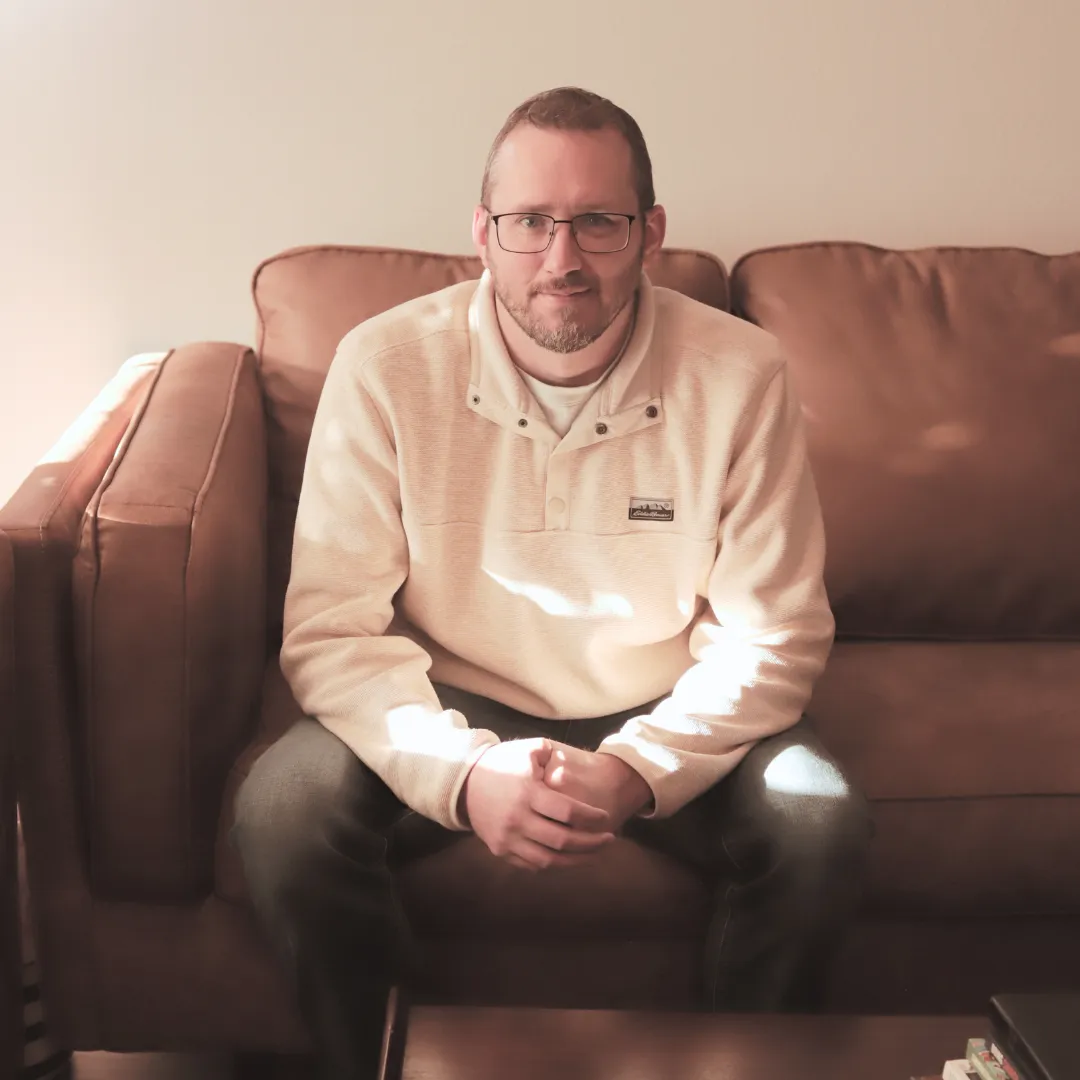
MEET THE FOUNDER & CEO
Built by a pastor, for Christian leaders. My system makes investing simple, strategic, and aligned with biblical principles.
Michael Shafer's Story:
“Facing the same financial uncertainty common among pastors, I stumbled upon a side hustle 15 years ago that revolutionized not just my finances, but my ability to serve in ministry without the looming stress of financial insecurity. This journey led me to a significant realization: financial freedom and ministry can coexist beautifully.”
But this isn't about Michael's journey...
Here are some real-life stories from others in the community

"His process works!"
“I have done this program consistently for six months now. For the eight out of the last 10 weeks, I have hit my weekly target in profit that allows me to pay a targeted portion of my bills without using my paycheck. Any Pastor should consider working with Michael because it is clear that he 100% cares about helping you make sure your financial future is more secure. There is no other agenda. And his process works!”
- Adam W., Arkansas

"I took control of my IRA"
“Using the method of investing I have learned through the program, we have been able to gain traction in our retirement programs and took control of our IRAs. I did not understand how to invest our portfolios and used mangers that cost 6%+ per year. This created a strain on our retirement during long term down periods in the market. We have gained more than the cost of the program in several days.”
- Aaron S., Oklahoma
"My account has grown 65.5%!!"
"I made my first trade with real money one year ago. I had $2400 in my account. Closing today’s trade, my account has grown 65.5%!! This year alone it has grown 31.4% in 3 months. I want to say thank you for all you have taught me. I don’t know how often you are told that you are making a difference for pastors/missionaries in the area of finances, but you are definitely helping me."
- Lew J., Kenya
"The side-hustle I've been looking for."
“This has been exactly the kind of side-hustle I was looking for. I needed someone I could trust to teach me how to get more time back and stop doing side gigs that take hours of my time and eat away at my ministry focus. Plus, I make more money with this. A double win!"
- Will D., Arkansas
These stories are individual experiences, not guarantees. Trading involves real financial risk, and many learners will experience losses as they grow. Only trade with capital you can afford to lose.
Choose Your Best Next Step
A. Just Exploring?
B. Brand New to Investing?
C. Ready to See Trades In Real Time?
IMPORTANT RISK DISCLOSURE
Trading and investing involve substantial risk and are not suitable for all individuals. Past performance is not indicative of future results, and no trading strategy, system, or approach can guarantee profits or protect against losses in all market conditions.
Stocks for Pastors and its instructors provide educational content only. We do not provide personalized investment, legal, or tax advice, and we do not make recommendations tailored to any individual’s financial situation. All examples, trade structures, and performance discussions are for educational and illustrative purposes.
Options trading, including spreads, involves defined risk but can still result in the loss of capital. Futures, options on futures, and securities trading carry a high level of risk and should only be undertaken with funds you can afford to lose. You are solely responsible for understanding the risks involved and for all trading decisions you make.
While we strive to present accurate and timely information, Stocks for Pastors makes no guarantees regarding the completeness or accuracy of data, pricing, or market information, which may change without notice. Errors, omissions, or delays may occur due to market conditions or third-party data sources.
All content reflects the opinions of the presenter at the time of publication and may change as market conditions evolve. Nothing presented should be interpreted as a solicitation, recommendation, or endorsement of any specific security or trading strategy.
Trading requires discipline, emotional control, and sound judgment. Even well-structured systems can experience drawdowns and periods of underperformance. Losses are a normal part of trading, and results will vary from trader to trader.
By participating in Stocks for Pastors content, programs, or events, you acknowledge and accept these risks and agree that you are responsible for your own financial decisions.


© 2025 G6 Allies - All Rights Reserved


