Learn Short-Term Investing From a Pastor, With a Plan That Honors Your Faith
A guided options income plan for Christians who want steady, realistic income growth—without gambling, hype, or endless screen time.

Trusted by pastors, missionaries, and church leaders worldwide
If You Love Jesus and Also Want More Income… You’re Not Crazy
You’ve given your life to ministry and serving others. You live modestly. You trust God to provide. But you also feel the weight of retirement, college, and future expenses, and you wonder if learning short‑term investing is wise, or if it will pull your heart in the wrong direction.
This is probably for you if...
You’ve dabbled in investing or trading but never found a plan you trust.
Some months you’re up, then you give it all back, and your balance trends sideways or down.
You want more income, but not at the cost of your peace, your integrity, or your calling.
A Guided Income Plan Built on Biblical Wisdom, Designed for Steady Income
This membership helps faith‑driven traders pursue consistent monthly income over time by combining four biblical guardrails, a simple market lens, defined‑risk options spreads, and a fixed‑ratio compounding plan.
Faith-Based Guardrails
Four principles from Proverbs shape every decision: risk comes first, discipline is non‑negotiable, trade the long view, and never treat trading as something you can simply copy.
Defined-Risk Strategies
Every trade uses simple spread structures with a clearly defined maximum loss before you ever enter. If the risk isn’t clear, the trade doesn’t happen.
A Clear Compounding Plan
Position size grows only after realized profits justify it, using a fixed‑ratio approach that favors steady progress over emotional swings.
How the System Works
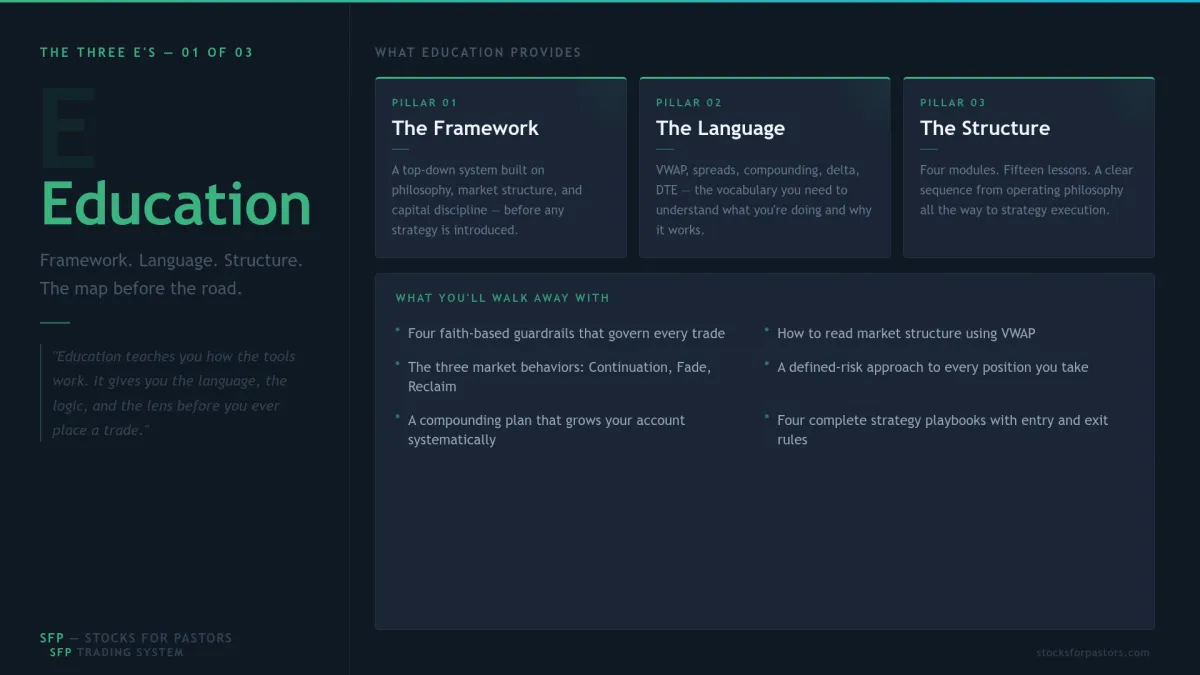
Step 1: Get the Map
Short, focused lessons give you the framework, language, and structure: faith‑based principles, VWAP market lens, risk rules, and strategy playbooks, so you’re not guessing or piecing together random strategies.
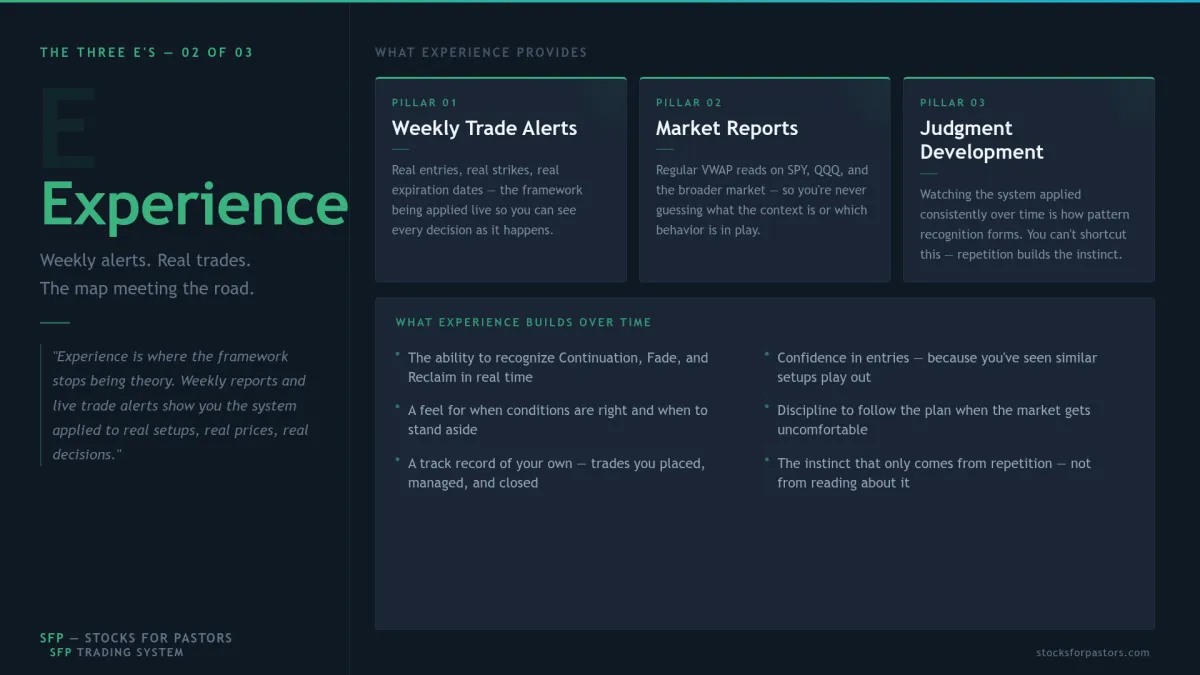
Step 2: See Real Trades
Weekly reports and trade alerts show you the exact setups, entries, and exits, with risk defined in dollars, so the map meets real trades so you can see how those principles look in real trades.
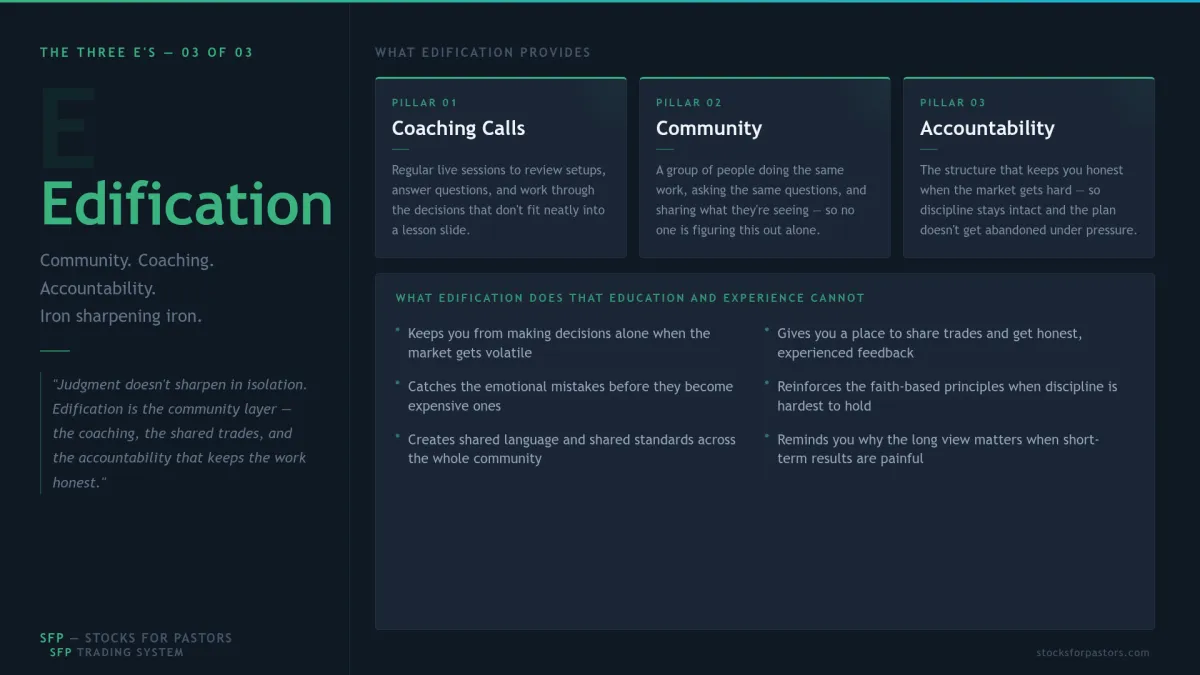
Step 3: Grow in Community
Live coaching calls and a like‑minded community help you stay disciplined, process emotions, and keep your trading aligned with your faith so discipline and peace can grow alongside your skill.
Read Our Latest Blogs
Lorem ipsum dolor sit amet, consectetur adipiscing elit.

How to Invest Without It Consuming You: Boundaries Every Pastor Needs
Boundaries Every Pastor Needs
Many pastors hesitate to invest not because they doubt whether it works, but because they fear what it might cost them mentally. Ministry already carries a heavy emotional load, one that does not shut off at the end of the workday. Sermon preparation, counseling conversations, leadership decisions, and the quiet weight of caring for people all demand sustained emotional attention. Adding markets, charts, prices, and headlines to that mix can feel like stacking one more responsibility onto an already full plate.
For many pastors, the concern is not financial risk as much as mental fatigue. They worry that investing will follow them everywhere, pulling their thoughts away during prayer, family time, or moments of rest. That fear is understandable, because without structure, investing can easily expand beyond its proper place.
That hesitation is not a weakness. It is a signal that you value focus, presence, and peace. It reflects a healthy instinct to protect your attention and emotional energy. The problem is not investing itself. The problem is investing without boundaries, without clear limits on time, focus, and mental space.
The Real Risk Is Not Money, It Is Distraction
Money is not inherently dangerous. Distraction is.
When investing becomes reactive, it competes for attention that pastors cannot afford to lose. Constant monitoring pulls your mind away from people, prayer, preparation, and rest. Over time, even small decisions begin to carry emotional weight they were never meant to hold.
Investing done without structure tends to expand into every available mental space. Investing done with boundaries stays contained and purposeful. The difference is not discipline alone. It is design.
Why Pastors Are Especially Vulnerable to Over-Involvement
Pastors are wired to care deeply. You take responsibility seriously. You carry outcomes that are not fully in your control. That same wiring, when applied to investing, can lead to overthinking and over-engagement.
Many pastors struggle to disengage mentally once a decision is made. They replay scenarios. They wonder if they missed something. They feel responsible for every result. This is not a character flaw. It is a leadership trait applied in the wrong context.
Boundaries help redirect that strength rather than suppress it.
Boundary One: Decide How Much Time Investing Is Allowed to Take
Before you place a trade, decide how much time investing is allowed to occupy in your week. This boundary matters more than most technical decisions because time is the resource you never get back. Without a clear limit, investing tends to expand quietly until it fills every open moment and every idle thought.
A healthy framework might include:
• A short weekly review window that has a clear beginning and end
• A monthly planning session to set direction instead of reacting week by week
• No checking prices outside those designated times
• Clear start and stop points that signal when your attention is released
These limits do more than manage a schedule. They train your mind to trust the process you have already put in place. When you know there is a defined time to review and act, the urge to constantly monitor fades. Time boundaries protect your attention and preserve your emotional energy. They prevent investing from bleeding into moments meant for family, rest, prayer, and ministry, and they allow you to stay fully present where you are most needed.
Boundary Two: Separate Investing From Identity and Worth
One of the fastest ways investing becomes unhealthy is when results start to define you. This shift often happens quietly, without intention. What begins as simple tracking slowly turns into emotional attachment.
Wins feel affirming because they validate your choices. Losses feel personal because they challenge your confidence. Over time, money stops functioning as a tool and starts behaving like a scoreboard that measures competence, discipline, or even worth.
Healthy investing requires intentional emotional separation. Your worth is not tied to outcomes, and your character is not revealed by a profit or a loss. A good decision can still lose money because markets are probabilistic, not moral. A poor decision can still make money because randomness exists. Neither outcome defines you.
When identity becomes entangled with results, emotions begin to override judgment. Decisions become heavier than they should be. Boundaries restore perspective and keep investing in its proper place as a tool that serves your life rather than a measure of who you are.
Boundary Three: Use Systems Instead of Willpower
Willpower fades quickly. Systems endure because they remove pressure from the moment of decision.
Clear rules, checklists, and predefined setups reduce the number of choices you have to make in real time. Instead of constantly evaluating, second guessing, or debating your next move, you operate from decisions that were already made when your mind was clear. This creates consistency without mental strain and protects you from emotional fatigue.
When systems are in place, investing stops feeling like a series of ongoing judgments and starts functioning like a routine. You are no longer asking what to do each day. You are following a process you trust. That shift matters, especially for pastors who already make dozens of weighty decisions every week.
This is why structured approaches matter so much. Seasonal watchlists narrow your focus. Defined setups eliminate guesswork. Automated processes reduce the temptation to intervene emotionally. Together, these systems lower the cognitive load of investing and keep it contained. Instead of becoming another mental drain, investing becomes a quiet, repeatable practice that supports your life rather than competing with it.
Boundary Four: Limit Information Intake
More information does not always lead to better decisions. Often it leads to confusion and unnecessary tension. When you are constantly exposed to opinions, predictions, and breaking news, your mind stays in a reactive state. Instead of following a clear plan, you begin responding to whatever feels most urgent in the moment.
News cycles thrive on urgency because urgency drives attention. Opinions multiply anxiety by presenting endless interpretations of the same data. Most daily market commentary has little relevance to long-term or rules-based investing, yet it can quietly shape your emotions if you consume it regularly. Over time, this creates mental clutter that makes even simple decisions feel heavy.
Limiting your inputs sharpens focus and restores clarity. Fewer voices make it easier to hear your own reasoning. Discernment grows when noise is reduced, because you are no longer sorting through constant external pressure. By choosing what you allow into your mind, you protect your ability to think calmly, act intentionally, and remain steady in your approach.
How These Boundaries Are Built Into Our Approach
Everything I teach is designed to protect mental margin, because margin is not optional for healthy leadership. Without it, even good opportunities can become sources of pressure. When mental space is crowded, clarity disappears and wise decisions become harder to make. Protecting margin is not about doing less. It is about doing the right things in the right measure.
Bootcamp focuses on simplicity and structure so new investors are not overwhelmed at the starting line. Foundations introduces rhythm and defined income tools that fit into real life, not ideal schedules. Income Accelerator adds complexity only where rules, systems, and emotional discipline already exist. Nothing is added until the foundation can support it.
The goal is never constant engagement with the market. The goal is calm consistency that operates quietly in the background of your life. Investing should not demand your attention every day or occupy your thoughts at random moments. It should function within clear boundaries that you set ahead of time.
Investing should serve your life, not consume it. Financial margin includes mental margin, emotional margin, and relational margin. Boundaries honor stewardship because they protect what matters most, your calling, your family, and your ability to be fully present.
You are allowed to invest without obsession. You are allowed to plan for the future without letting money dominate your thinking. You are allowed to grow financially while remaining grounded and attentive today.
Peace is not a byproduct of success. It is a design choice you make through structure, boundaries, and intentional restraint.


MEET THE FOUNDER & CEO
Built by a pastor, for Christian leaders. My system makes investing simple, strategic, and aligned with biblical principles.
Michael Shafer's Story:
“Facing the same financial uncertainty common among pastors, I stumbled upon a side hustle 15 years ago that revolutionized not just my finances, but my ability to serve in ministry without the looming stress of financial insecurity. This journey led me to a significant realization: financial freedom and ministry can coexist beautifully.”
But this isn't about Michael's journey...
Here are some real-life stories from others in the community

"His process works!"
“I have done this program consistently for six months now. For the eight out of the last 10 weeks, I have hit my weekly target in profit that allows me to pay a targeted portion of my bills without using my paycheck. Any Pastor should consider working with Michael because it is clear that he 100% cares about helping you make sure your financial future is more secure. There is no other agenda. And his process works!”
- Adam W., Arkansas


"I took control of my IRA"
“Using the method of investing I have learned through the program, we have been able to gain traction in our retirement programs and took control of our IRAs. I did not understand how to invest our portfolios and used mangers that cost 6%+ per year. This created a strain on our retirement during long term down periods in the market. We have gained more than the cost of the program in several days.”
- Aaron S., Oklahoma

"My account has grown 65.5%!!"
"I made my first trade with real money one year ago. I had $2400 in my account. Closing today’s trade, my account has grown 65.5%!! This year alone it has grown 31.4% in 3 months. I want to say thank you for all you have taught me. I don’t know how often you are told that you are making a difference for pastors/missionaries in the area of finances, but you are definitely helping me."
- Lew J., Kenya

"The side-hustle I've been looking for."
“This has been exactly the kind of side-hustle I was looking for. I needed someone I could trust to teach me how to get more time back and stop doing side gigs that take hours of my time and eat away at my ministry focus. Plus, I make more money with this. A double win!"
- Will D., Arkansas
These stories are individual experiences, not guarantees. Trading involves real financial risk, and many learners will experience losses as they grow. Only trade with capital you can afford to lose.
Choose Your Best Next Step
A. Just Exploring?
B. Brand New to Investing?
C. Ready to See Trades In Real Time?
IMPORTANT RISK DISCLOSURE
Trading and investing involve substantial risk and are not suitable for all individuals. Past performance is not indicative of future results, and no trading strategy, system, or approach can guarantee profits or protect against losses in all market conditions.
Stocks for Pastors and its instructors provide educational content only. We do not provide personalized investment, legal, or tax advice, and we do not make recommendations tailored to any individual’s financial situation. All examples, trade structures, and performance discussions are for educational and illustrative purposes.
Options trading, including spreads, involves defined risk but can still result in the loss of capital. Futures, options on futures, and securities trading carry a high level of risk and should only be undertaken with funds you can afford to lose. You are solely responsible for understanding the risks involved and for all trading decisions you make.
While we strive to present accurate and timely information, Stocks for Pastors makes no guarantees regarding the completeness or accuracy of data, pricing, or market information, which may change without notice. Errors, omissions, or delays may occur due to market conditions or third-party data sources.
All content reflects the opinions of the presenter at the time of publication and may change as market conditions evolve. Nothing presented should be interpreted as a solicitation, recommendation, or endorsement of any specific security or trading strategy.
Trading requires discipline, emotional control, and sound judgment. Even well-structured systems can experience drawdowns and periods of underperformance. Losses are a normal part of trading, and results will vary from trader to trader.
By participating in Stocks for Pastors content, programs, or events, you acknowledge and accept these risks and agree that you are responsible for your own financial decisions.


© 2025 G6 Allies - All Rights Reserved


