
Learn Short-Term Investing From a Pastor, With a Plan That Honors Your Faith
A guided options income plan for Christians who want steady, realistic income growth—without gambling, hype, or endless screen time.

Trusted by pastors, missionaries, and church leaders worldwide
If You Love Jesus and Also Want More Income… You’re Not Crazy
You’ve given your life to ministry and serving others. You live modestly. You trust God to provide. But you also feel the weight of retirement, college, and future expenses, and you wonder if learning short‑term investing is wise, or if it will pull your heart in the wrong direction.
This is probably for you if...
You’ve dabbled in investing or trading but never found a plan you trust.
Some months you’re up, then you give it all back, and your balance trends sideways or down.
You want more income, but not at the cost of your peace, your integrity, or your calling.
A Guided Income Plan Built on Biblical Wisdom, Designed for Steady Income
This membership helps faith‑driven traders pursue consistent monthly income over time by combining four biblical guardrails, a simple market lens, defined‑risk options spreads, and a fixed‑ratio compounding plan.
Faith-Based Guardrails
Four principles from Proverbs shape every decision: risk comes first, discipline is non‑negotiable, trade the long view, and never treat trading as something you can simply copy.
Defined-Risk Strategies
Every trade uses simple spread structures with a clearly defined maximum loss before you ever enter. If the risk isn’t clear, the trade doesn’t happen.
A Clear Compounding Plan
Position size grows only after realized profits justify it, using a fixed‑ratio approach that favors steady progress over emotional swings.
How the System Works
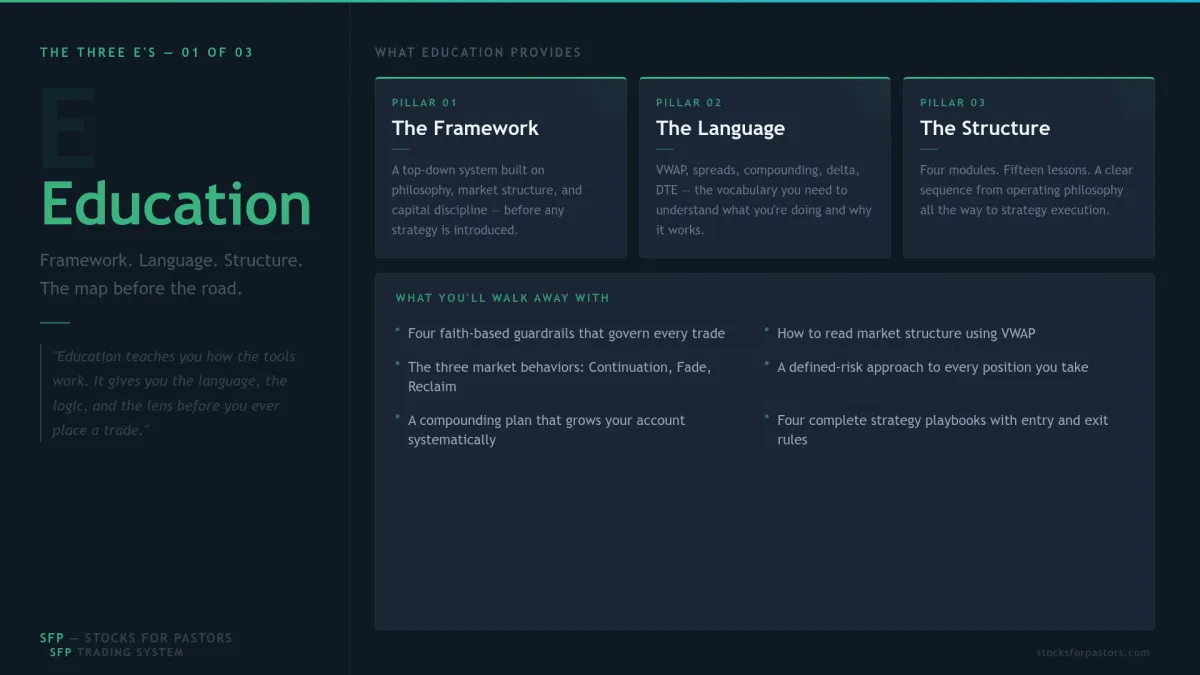
Step 1: Get the Map
Short, focused lessons give you the framework, language, and structure: faith‑based principles, VWAP market lens, risk rules, and strategy playbooks, so you’re not guessing or piecing together random strategies.
Step 2: See Real Trades
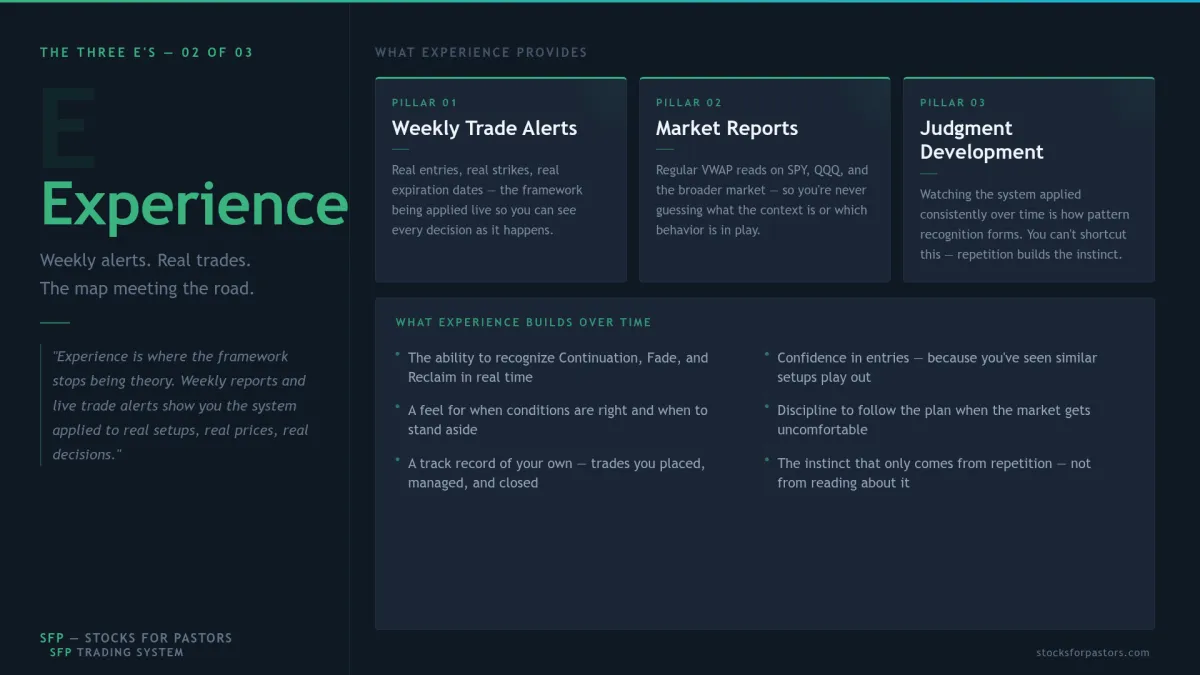
Weekly reports and trade alerts show you the exact setups, entries, and exits, with risk defined in dollars, so the map meets real trades so you can see how those principles look in real trades.
Step 3: Grow in Community
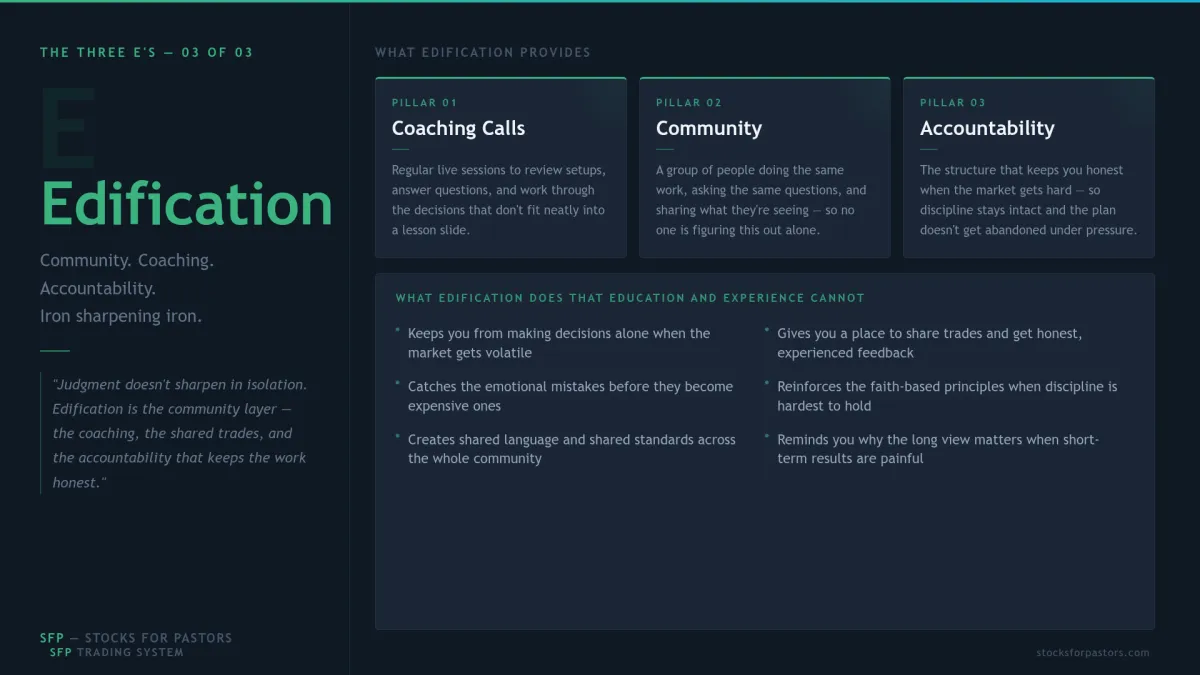
Live coaching calls and a like‑minded community help you stay disciplined, process emotions, and keep your trading aligned with your faith so discipline and peace can grow alongside your skill.
Read Our Latest Blogs
Lorem ipsum dolor sit amet, consectetur adipiscing elit.
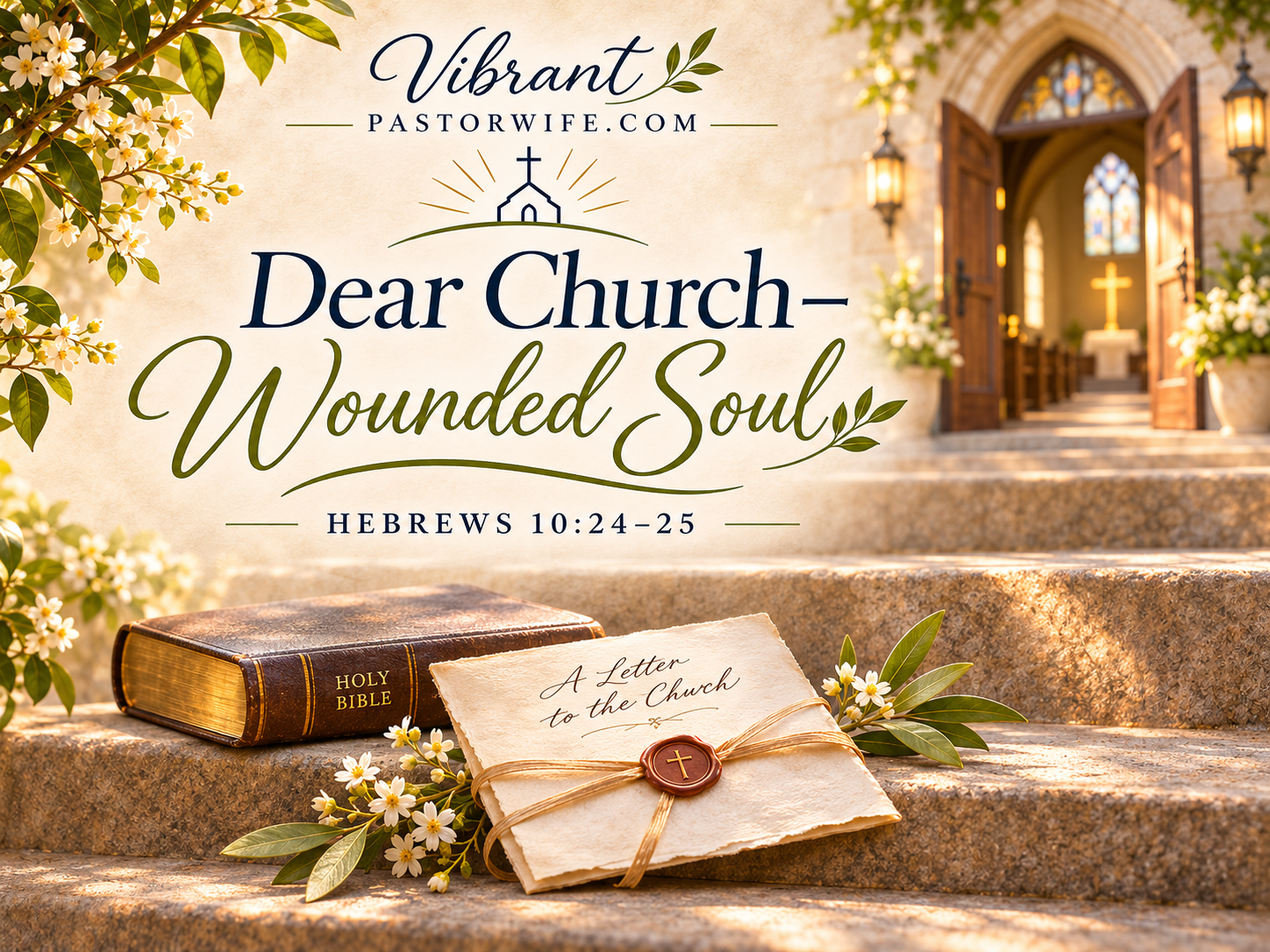
Hurt by the Church? A Letter to Wounded Pastor’s Wives
Dear Church-Wounded Soul
“And let us consider how to stir up one another to love and good works, not neglecting to meet together…” Hebrews 10:24–25
We know a whole lot about stirring one another up, don’t we? We stir the pot. We push buttons. We get under each other’s skin. And more often than not, the result is frustration, irritation, and a whole lot of hurt feelings. Social media has practically turned stirring people up into an Olympic sport.
But what if we considered stirring from an entirely different angle? What if, instead of stirring one another toward frustration and division, we intentionally stirred one another toward love and good works? What a foreign concept.
Now, consider for a moment that perhaps our entire understanding of why we “do” church has become a little skewed. What if church isn’t something we do at all? What if church is something we are? Once we begin to wrap our minds around that truth, the conversation about church hurt becomes much more personal. Because if the church is not simply a place we attend or an activity we participate in, but a body we actually belong to, then suddenly we have to acknowledge something uncomfortable. We are individually responsible for how the world experiences the body as a whole.
And when we add the biblical instruction to stir one another toward love and good works, the responsibility becomes even greater. It’s no longer simply the pastor’s job to hold everything together, encourage everyone, mend every wound, and somehow keep all the people happy. It’s a full-body effort. Every single one of us has a part to play. And that’s where things get messy.
Somewhere along the way, we seem to have developed the idea that church should be a beautiful experience filled with smiles, warm feelings, uplifting music, emotional moments, and an abundance of positivity. And sometimes it is. But the reality? That’s not always reality. If each of us individually makes up a piece of the body of Christ, take a good, honest look at yourself for a moment. Consider your flaws, your insecurities, your struggles, your shortcomings, your unresolved issues, and the places where God is still doing some serious construction work. Now multiply that by every person sitting in your church. There you have it. A pretty accurate picture of the level of brokenness we’re dealing with. Suddenly, the picture of uninterrupted euphoria goes right out the window, and messy camaraderie becomes the reality. Welcome to the church. A whole bunch of broken people trying to walk together toward Jesus.
I hear from the church-wounded on a regular basis. Some sit on the back row, nursing their hurts in silence. Others make dramatic exits, ensuring everyone knows exactly why they’re leaving. And still others quietly slip through the cracks, disappearing out the back door, never to be seen or heard from again. And every time someone disappears, something is lost. A piece of the body is missing.
Sometimes people walk away because they were wounded in the very place they expected to find safety, love, and something that looked a whole lot like perfection. And I understand that. The hurt is real. The disappointment is real. The betrayal can be real. But perhaps the expectation itself needs some examination. Perfection cannot be produced by a collection of imperfect people. The church was never meant to be a gathering of people who have already arrived. It is a gathering of people who have recognized that they desperately need a Savior.
The only perfect person in the entire equation is Jesus. The rest of us? Well, we’re still under construction. We’re a collection of broken, sometimes sharp-edged people who have found salvation in one perfect Redeemer, and He’s calling us to walk together toward sanctification. That’s a big theological word that essentially means: “Ain’t none of us there yet!” And sometimes, as those sharp edges rub against one another, we hurt each other. Sometimes we also help shape each other into something useful and beautiful. Both can happen in the same body.
Here’s the uncomfortable truth about church wounds: Every one of us has been wounded, and every one of us has wounded someone else. Maybe intentionally. Maybe accidentally. Maybe with words we wish we could take back. Maybe through silence when someone desperately needed us to speak. But none of us gets to stand outside the circle and claim complete innocence.
I remember listening to a young woman pour out her heart about how badly the church had hurt her. Her pain was genuine. Her heart was broken. She desperately wanted things to be different, but the wounds she carried had convinced her that change was impossible. So she had decided to walk away from the church altogether. She was surprised when I challenged her reasoning. And she was even more surprised when I suggested that perhaps those very wounds had given her something valuable to offer the body of Christ.
Because here’s what I believe: Sometimes the people who know most intimately how the church can wound are the very people who can teach us how to love more carefully. Those who know what it feels like to be overlooked can become the ones who notice the forgotten. Those who have been excluded can become the ones who make room at the table. Those who have been silenced can become the ones who listen. Those who have experienced a lack of compassion can become the ones who extend it most generously. And those who know the pain of being wounded by fellow believers can become powerful instruments of healing.
Our wounds do not excuse the wrongs committed against us, nor do they obligate us to remain in abusive or unsafe environments. There are times when stepping away, establishing boundaries, and seeking accountability are absolutely necessary. But our wounds don’t have to have the final word, either. Sometimes the very places we’ve been hurt become the places where God teaches us how to love differently. And perhaps that’s part of what it means to stir one another toward love and good works. We use what we’ve learned through our pain to become more intentional about how we treat the people around us. Not because the hurt was good. But because God is able to bring something good even out of what hurt us.
And it’s difficult to stir one another toward anything when we’ve completely disconnected ourselves from one another. Hebrews reminds us not to neglect meeting together. Not because gathering magically makes every relationship healthy. Not because every church is safe. But because the Christian life was never intended to be lived in isolation. We need one another. Even when we’re messy. Especially when we’re messy.
And let me tell you something else. Being part of the church doesn’t mean the wounds stop coming. One of the most hurtful things ever said to me came during a particularly frustrating conversation. Someone was sharing a long list of things that had hurt them within the church over a relatively short period of time. Some of those things were, unintentionally, my fault. I listened. I tried to explain my heart. I wanted this person to understand that causing pain had never been my intention. And then, in an attempt to connect with their hurt, I shared that I, too, understood what it felt like to be wounded by the church. The response came quickly, angrily, and with enough force to cut straight through me.
“What could you possibly have to be hurt by?”
I still remember those words. Dozens of examples immediately rushed through my mind. Situations, conversations, disappointments, betrayals, and hurts that I had carried quietly. But none of them made it out of my mouth. Because in that moment, what hurt the most wasn’t the question itself. It was the assumption behind it. The assumption that because of my position, my pain somehow didn’t count. That because I was the pastor’s wife, I couldn’t possibly understand what it meant to be wounded by the very people I was called to love.
So let me make a confession. There isn’t a week that goes by that I don’t experience some sort of hurt within the church. Not one. There isn’t a week when I don’t have to swallow something I’d really like to say and replace it with a quiet smile because, quite frankly, Jesus wouldn’t say what I want to say. Sometimes I manage the smile. Sometimes I don’t. Sometimes I stay quiet. Sometimes I don’t do that very well, either. Because at the end of the day, I am one hundred percent human. I just happen to be a human living under the title of Pastor’s Wife. And contrary to what some may believe, that title does not come with a supernatural exemption from hurt feelings, frustration, disappointment, or the occasional temptation to say something that would require repentance later. I’m still being sanctified, too. Remember? Ain’t none of us there yet.
And that brings us right back to Hebrews 10:24–25. “And let us consider how to stir up one another to love and good works, not neglecting to meet together…” Notice that Scripture doesn’t tell us to consider how to make one another happy. It doesn’t tell us to make sure no one ever gets offended. It doesn’t tell us to avoid every uncomfortable conversation, overlook every wrong, or pretend that everything is fine when it clearly isn’t. It tells us to consider how to stir one another toward love and good works.
Sometimes that means speaking up. Sometimes it means being quiet. Sometimes it means confronting sin. Sometimes it means extending grace. Sometimes it means recognizing that the very thing irritating us about someone else may be the thing God is using to reveal something in our own hearts. Sometimes it means saying, “I’m sorry. I hurt you, and I was wrong.” And sometimes it means being gracious enough to receive those words and offer a bouquet of forgiveness in return. Sometimes it means having a difficult conversation rather than disappearing. Sometimes it means recognizing that reconciliation requires truth, repentance, and genuine change, not merely pretending the damage never happened. And sometimes love requires boundaries, because stirring one another toward good works should never become an excuse for allowing harm to continue.
But always, always, we are called to love. Not the easy kind of love that exists when everyone agrees, everyone behaves, and everyone remembers to bring something to the church potluck. The difficult kind. The kind that requires humility. The kind that makes room for imperfect people while still holding them accountable. The kind that tells the truth without abandoning compassion. The kind that acknowledges wounds without allowing bitterness to become our identity. The kind that remembers we are not the Savior of the church. Jesus is.
The church is not a collection of perfect people. It is a collection of redeemed people who are still being made whole. And while we are being made whole, we have the privilege and responsibility of helping one another along the way. The broken encourage the broken. The wounded help the wounded. The forgiven learn to forgive. The loved learn to love. And together, through all our awkwardness, failures, apologies, second chances, and beautiful moments of grace, we become a living picture of what redemption looks like. Not because we’ve figured it all out. Not because we never get it wrong. But because Jesus is still at work in us.
Dear church-wounded soul, your hurt matters. Your story matters. And so does the love you still have to give. Don’t allow the wounds you’ve experienced to convince you that the body of Christ has no place for you. Find a healthy place to heal, to grow, to belong, and, when you’re ready, to help others do the same. Because the church was never something we were simply supposed to do. It’s who we are.
And perhaps one of the most beautiful testimonies we can offer this broken world is not a picture of people who have never been hurt, but a picture of imperfect people learning, through Christ, how to stop wounding one another and start helping one another heal. That’s the church I want to be part of. That’s the church I want to help build. And that’s the kind of stirring I think we could all use a little more of.
“Let us consider how to stir up one another to love and good works.” — Hebrews 10:24

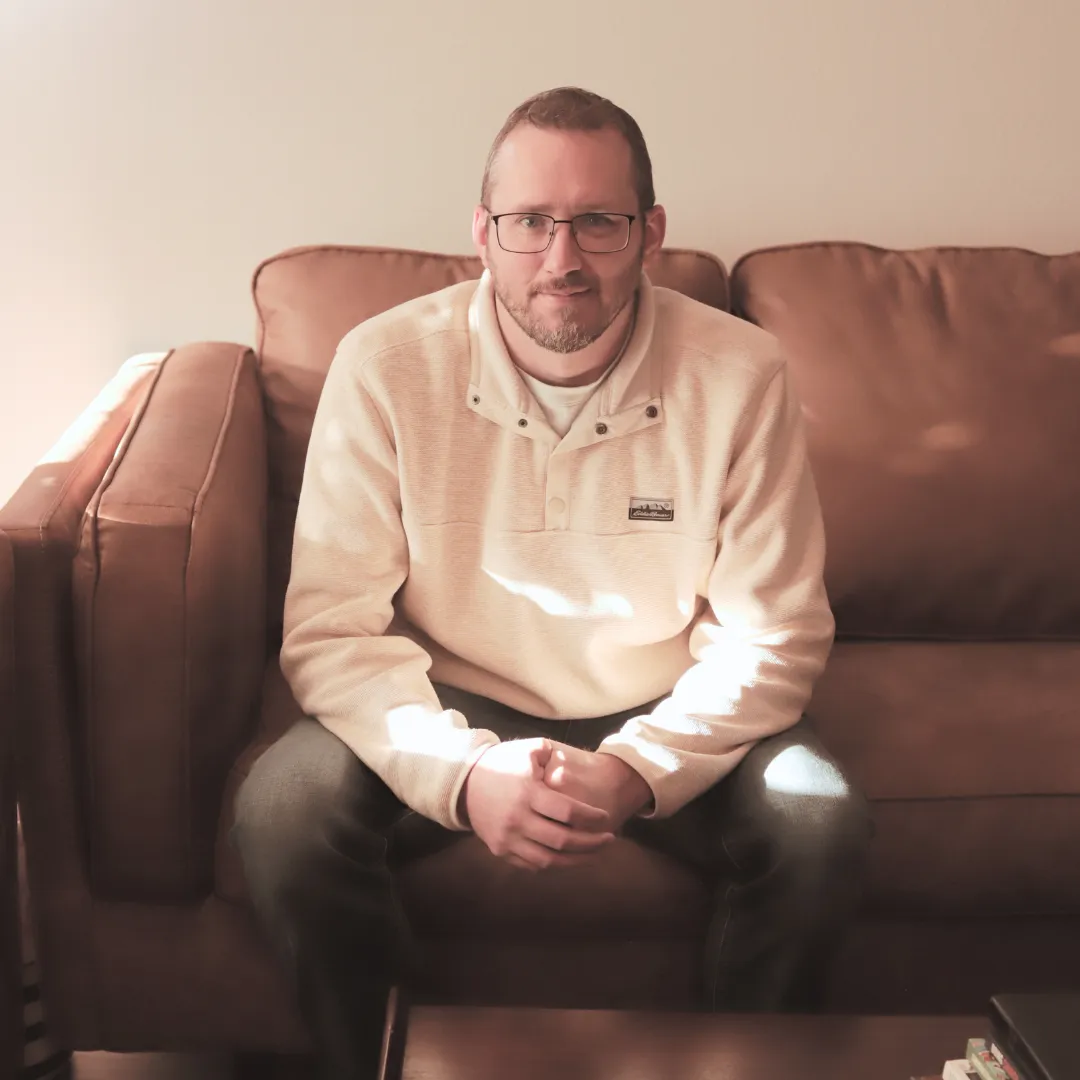
MEET THE FOUNDER & CEO
Built by a pastor, for Christian leaders. My system makes investing simple, strategic, and aligned with biblical principles.
Michael Shafer's Story:
“Facing the same financial uncertainty common among pastors, I stumbled upon a side hustle 15 years ago that revolutionized not just my finances, but my ability to serve in ministry without the looming stress of financial insecurity. This journey led me to a significant realization: financial freedom and ministry can coexist beautifully.”
But this isn't about Michael's journey...
Here are some real-life stories from others in the community

"His process works!"
“I have done this program consistently for six months now. For the eight out of the last 10 weeks, I have hit my weekly target in profit that allows me to pay a targeted portion of my bills without using my paycheck. Any Pastor should consider working with Michael because it is clear that he 100% cares about helping you make sure your financial future is more secure. There is no other agenda. And his process works!”
- Adam W., Arkansas

"I took control of my IRA"
“Using the method of investing I have learned through the program, we have been able to gain traction in our retirement programs and took control of our IRAs. I did not understand how to invest our portfolios and used mangers that cost 6%+ per year. This created a strain on our retirement during long term down periods in the market. We have gained more than the cost of the program in several days.”
- Aaron S., Oklahoma
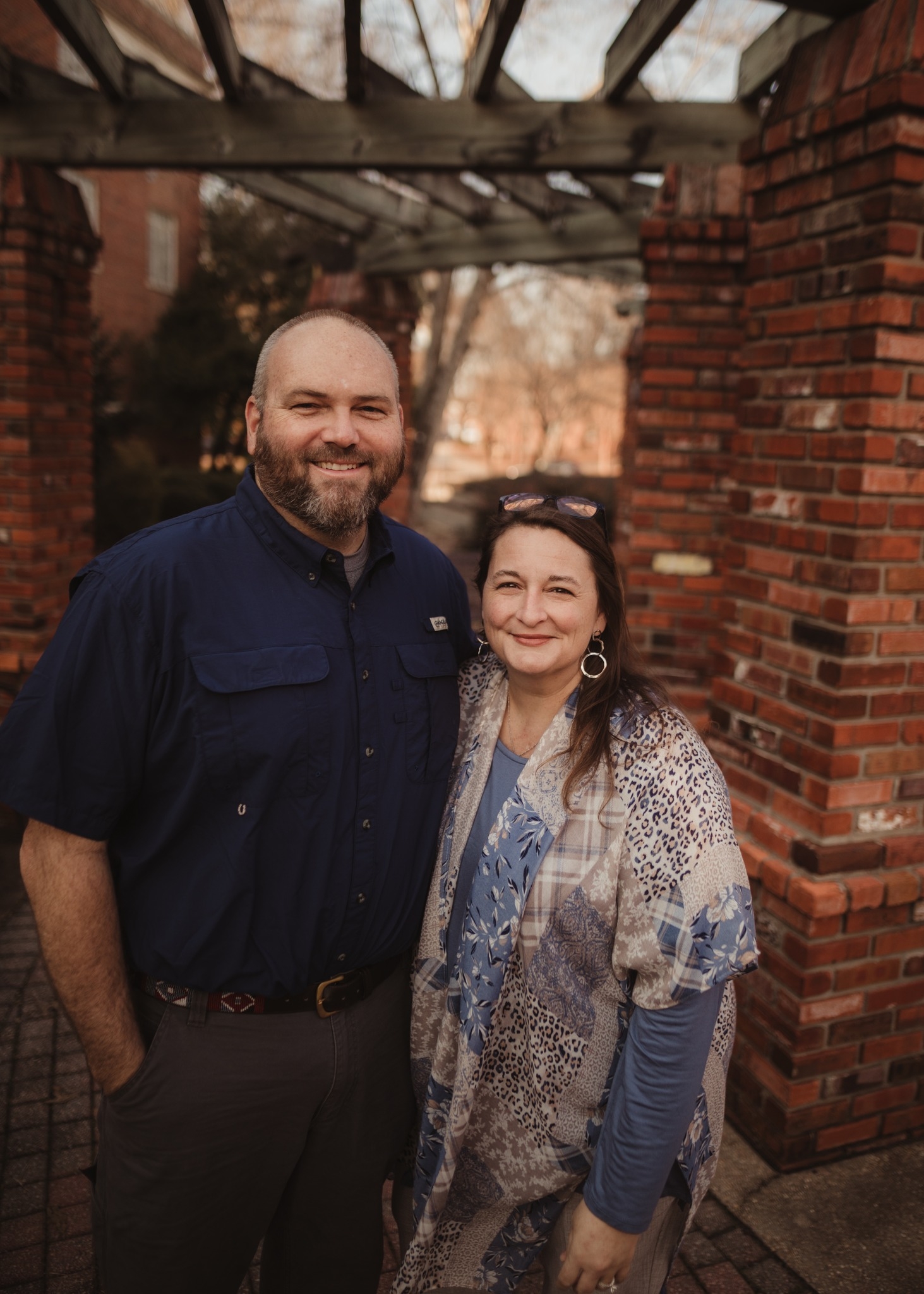
"My account has grown 65.5%!!"
"I made my first trade with real money one year ago. I had $2400 in my account. Closing today’s trade, my account has grown 65.5%!! This year alone it has grown 31.4% in 3 months. I want to say thank you for all you have taught me. I don’t know how often you are told that you are making a difference for pastors/missionaries in the area of finances, but you are definitely helping me."
- Lew J., Kenya
"The side-hustle I've been looking for."
“This has been exactly the kind of side-hustle I was looking for. I needed someone I could trust to teach me how to get more time back and stop doing side gigs that take hours of my time and eat away at my ministry focus. Plus, I make more money with this. A double win!"
- Will D., Arkansas
These stories are individual experiences, not guarantees. Trading involves real financial risk, and many learners will experience losses as they grow. Only trade with capital you can afford to lose.
Choose Your Best Next Step
A. Just Exploring?
B. Brand New to Investing?
C. Ready to See Trades In Real Time?
IMPORTANT RISK DISCLOSURE
Trading and investing involve substantial risk and are not suitable for all individuals. Past performance is not indicative of future results, and no trading strategy, system, or approach can guarantee profits or protect against losses in all market conditions.
Stocks for Pastors and its instructors provide educational content only. We do not provide personalized investment, legal, or tax advice, and we do not make recommendations tailored to any individual’s financial situation. All examples, trade structures, and performance discussions are for educational and illustrative purposes.
Options trading, including spreads, involves defined risk but can still result in the loss of capital. Futures, options on futures, and securities trading carry a high level of risk and should only be undertaken with funds you can afford to lose. You are solely responsible for understanding the risks involved and for all trading decisions you make.
While we strive to present accurate and timely information, Stocks for Pastors makes no guarantees regarding the completeness or accuracy of data, pricing, or market information, which may change without notice. Errors, omissions, or delays may occur due to market conditions or third-party data sources.
All content reflects the opinions of the presenter at the time of publication and may change as market conditions evolve. Nothing presented should be interpreted as a solicitation, recommendation, or endorsement of any specific security or trading strategy.
Trading requires discipline, emotional control, and sound judgment. Even well-structured systems can experience drawdowns and periods of underperformance. Losses are a normal part of trading, and results will vary from trader to trader.
By participating in Stocks for Pastors content, programs, or events, you acknowledge and accept these risks and agree that you are responsible for your own financial decisions.


© 2025 G6 Allies - All Rights Reserved


