
Learn Short-Term Investing From a Pastor, With a Plan That Honors Your Faith
A guided options income plan for Christians who want steady, realistic income growth—without gambling, hype, or endless screen time.

Trusted by pastors, missionaries, and church leaders worldwide
If You Love Jesus and Also Want More Income… You’re Not Crazy
You’ve given your life to ministry and serving others. You live modestly. You trust God to provide. But you also feel the weight of retirement, college, and future expenses, and you wonder if learning short‑term investing is wise, or if it will pull your heart in the wrong direction.
This is probably for you if...
You’ve dabbled in investing or trading but never found a plan you trust.
Some months you’re up, then you give it all back, and your balance trends sideways or down.
You want more income, but not at the cost of your peace, your integrity, or your calling.
A Guided Income Plan Built on Biblical Wisdom, Designed for Steady Income
This membership helps faith‑driven traders pursue consistent monthly income over time by combining four biblical guardrails, a simple market lens, defined‑risk options spreads, and a fixed‑ratio compounding plan.
Faith-Based Guardrails
Four principles from Proverbs shape every decision: risk comes first, discipline is non‑negotiable, trade the long view, and never treat trading as something you can simply copy.
Defined-Risk Strategies
Every trade uses simple spread structures with a clearly defined maximum loss before you ever enter. If the risk isn’t clear, the trade doesn’t happen.
A Clear Compounding Plan
Position size grows only after realized profits justify it, using a fixed‑ratio approach that favors steady progress over emotional swings.
How the System Works
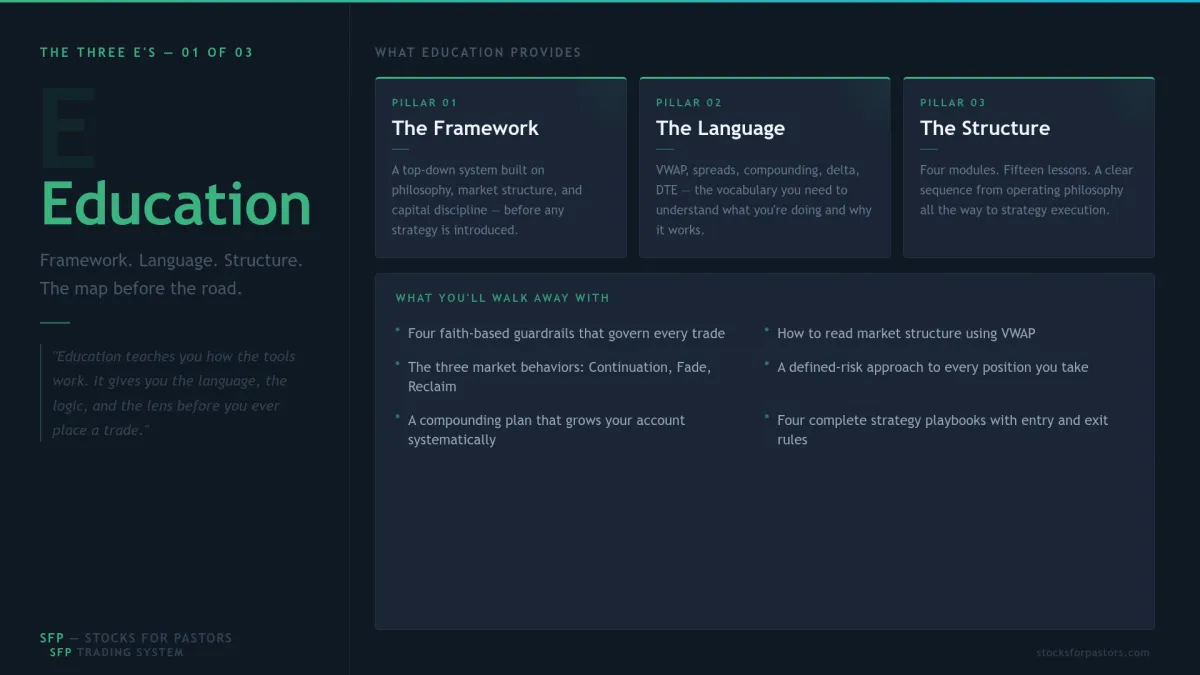
Step 1: Get the Map
Short, focused lessons give you the framework, language, and structure: faith‑based principles, VWAP market lens, risk rules, and strategy playbooks, so you’re not guessing or piecing together random strategies.
Step 2: See Real Trades
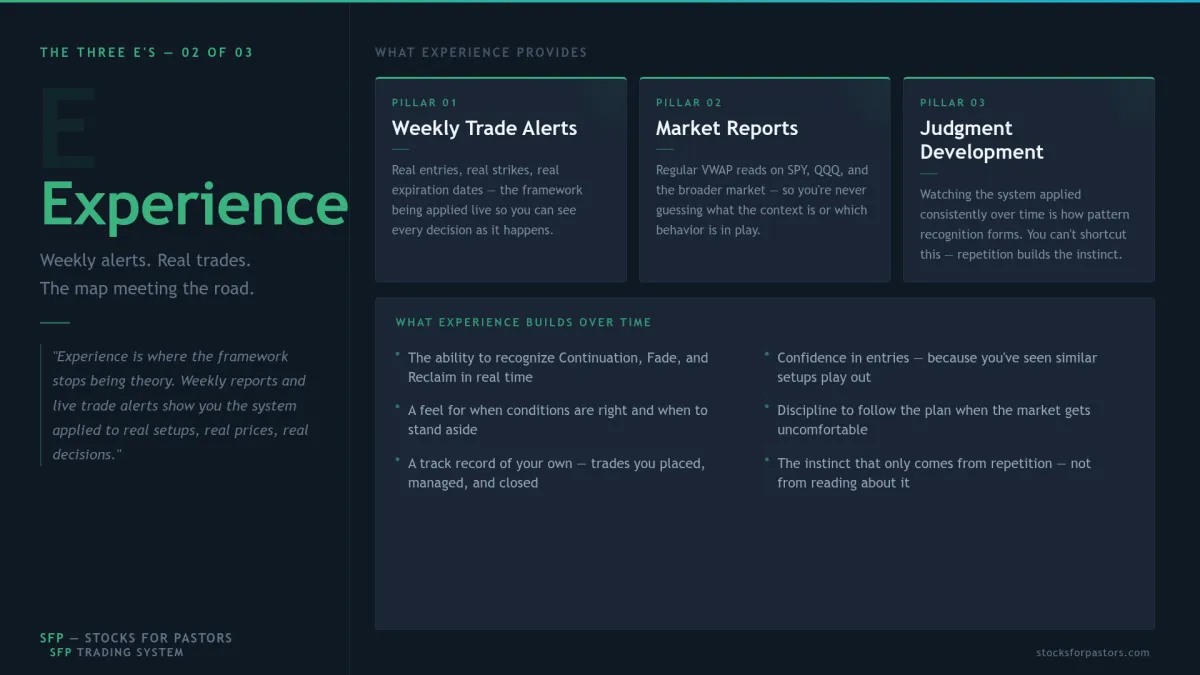
Weekly reports and trade alerts show you the exact setups, entries, and exits, with risk defined in dollars, so the map meets real trades so you can see how those principles look in real trades.
Step 3: Grow in Community
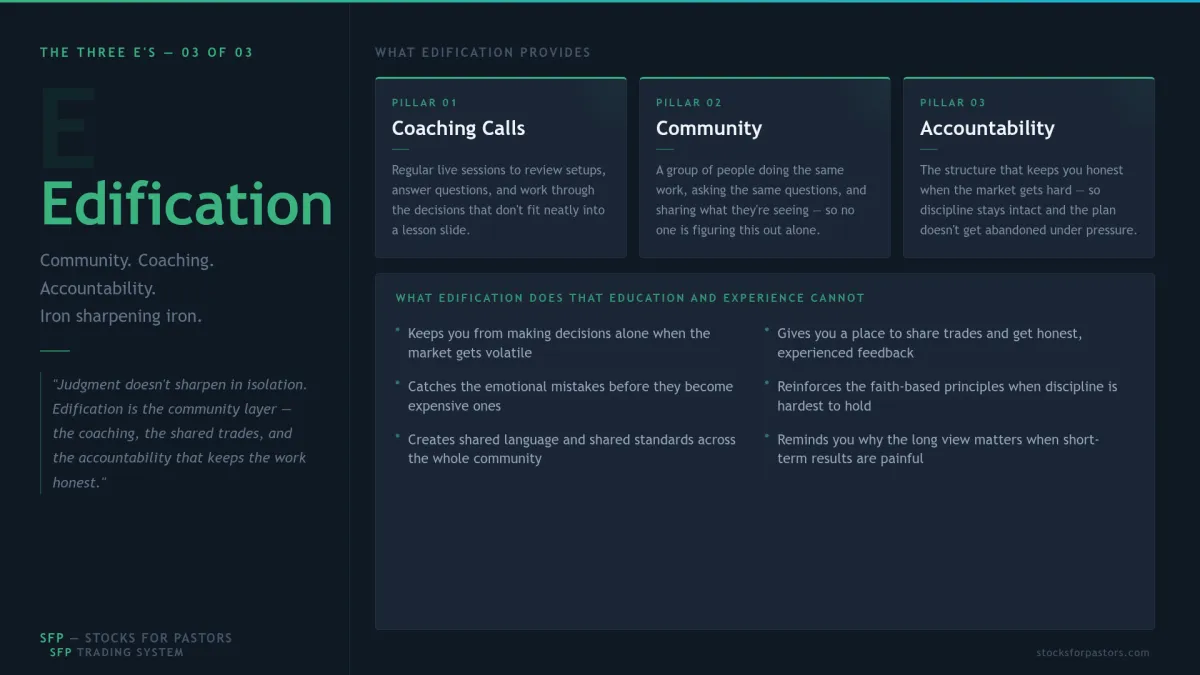
Live coaching calls and a like‑minded community help you stay disciplined, process emotions, and keep your trading aligned with your faith so discipline and peace can grow alongside your skill.
Read Our Latest Blogs
Lorem ipsum dolor sit amet, consectetur adipiscing elit.

Living Before an Audience of One: What Genesis 3 Teaches About the Fear of Man
The fear of man began in the Garden, but the gospel sets us free.
We all know what it feels like to wonder what someone else is thinking. Maybe it's the church member whose facial expression changes while you're teaching a Bible study. Or perhaps it's the friend whose social media post makes you question your own parenting. As a pastor's wife, maybe it's the quiet pressure you feel every Sunday morning to look put together, say the right thing, and make sure no one notices the places where you still feel unfinished.
Whether we're willing to admit it or not, we spend a surprising amount of time managing other people's perceptions. We replay conversations, overanalyze text messages, and hesitate to obey God because we're worried about how someone else might respond. Sometimes we even confuse the approval of others with the approval of God.
Our culture offers plenty of explanations for why we care so deeply about what people think. We blame social media, personality, childhood experiences, or even ministry culture. While those things may contribute to the struggle, Scripture points us somewhere much deeper. The fear of man didn't begin with social media or church culture. It began in a garden.
If we want to understand why the opinions of others carry so much weight, we have to return to Genesis. There we discover that the fear of man is not simply a personality trait to overcome. It is one of the many ways sin distorted God's good design.
Before Sin, There Was Only One Audience
The closing verse of Genesis 2 is easy to overlook:
"And the man and his wife were both naked and were not ashamed." (Genesis 2:25, ESV)
Before sin entered the world, Adam and Eve had nothing to hide, nothing to prove, and nothing to protect. Their identity wasn't something they had to manufacture because it had already been given to them by their Creator. They lived in joyful dependence upon God, and because their eyes were fixed on Him, they weren't consumed with themselves.
This is God's original design. Their attention wasn't fixed on their image, their reputation, or each other's opinions. It was fixed on God. As long as their fellowship with Him remained whole, there was no room for the insecurity that so often consumes us today.
That observation reveals something profound about the human heart: self-consciousness flourishes wherever God-consciousness fades. The more consumed we become with our image, our reputation, our success, or our acceptance, the less occupied we become with the God who created us. We were made to know Him before we were ever tempted to impress people, and where our focus is misaligned, dissonance grows.
Sin Turned Our Eyes Toward Ourselves
Everything changed in Genesis 3. The serpent didn't begin by tempting Eve to rebel. He invited her to question the goodness of God.
"Did God actually say...?" (Genesis 3:1)
Satan's first attack wasn't aimed at Eve's behavior but at her trust. He planted the suspicion that perhaps God was withholding something good. Once distrust entered her heart, disobedience followed.
Then something remarkable happened.
"Then the eyes of both were opened, and they knew that they were naked. And they sewed fig leaves together and made themselves loincloths." (Genesis 3:7, ESV)
Moments earlier, Adam and Eve had been naked and unashamed. Now they were painfully aware of their exposure. Shame entered the story, and with it came fear, hiding, and self-preservation. Notice the progression: they distrusted God, disobeyed His command, covered themselves, and hid from His presence. Sin didn't simply separate humanity from God; it distorted the way humanity viewed itself. People who had known that they were cherished by their Creator suddenly felt unworthiness.
Instead of running to the God who had always loved them, Adam and Eve tried to solve a spiritual problem with human effort. They reached for fig leaves because shame always convinces us that if we can just cover ourselves well enough, no one will notice what's underneath. We still respond much the same way. Sometimes we smile when we're hurting. Sometimes we overachieve because success feels safer than weakness. Sometimes we quietly become the person we think everyone expects us to be. The fig leaves have changed, but the instinct has not.
Once our eyes turn away from God and toward ourselves, it isn't long before they also turn toward everyone else's opinions. We begin measuring ourselves by questions God never intended to define us. What do they think of me? Am I enough? Did I disappoint them?
The fear of man isn't simply fearing rejection; it's allowing the opinions of people to become more authoritative than the voice of God. That is a burden we were never created to carry.
Our Modern Fig Leaves
The details of Genesis 3 may seem far removed from everyday life, but the human heart hasn't changed. Adam and Eve tried to cover their shame with fig leaves. We simply use different materials.
Some of us hide behind accomplishments, believing that if we succeed a little more, we'll finally feel secure. Others hide behind busyness, convincing ourselves that productivity proves our worth. Some stitch together ministry success, saying yes to every opportunity, not because God has called us to it, but because we're afraid of disappointing people. Others reach for perfectionism, polishing our image and quietly hoping no one notices the places where we still feel inadequate.
None of those things are sinful in themselves. The problem begins when we ask them to provide what only Christ can give: acceptance, security, identity, and approval. Whatever we believe will hide our shame eventually becomes our master, which is why performance is so exhausting. It never allows us to rest because it is always demanding one more accomplishment, one more compliment, one more reason to believe we're finally enough.
The finish line, however, never stops moving. People were never meant to determine our identity. Only God can bear that weight.
The Snare of Human Approval
Scripture doesn't simply tell us that fearing people is unwise. It tells us it is dangerous.
"The fear of man lays a snare, but whoever trusts in the LORD is safe." (Proverbs 29:25)
A snare is a trap. It captures its victim before they realize they're in danger, and that's exactly how the fear of man operates. It rarely begins with open rebellion. More often, it begins with good desires. We want people to like us. We want to represent Christ well. We want to avoid unnecessary conflict. None of those desires are sinful. But somewhere along the way, our desire to be loving can become a need to be liked, and our desire to serve can become a need to be validated. Without realizing it, we've exchanged faithfulness for approval. That's the snare.
We hesitate to speak truth because someone may disagree. We avoid difficult conversations because someone might be disappointed. We begin measuring obedience by people's reactions instead of God's pleasure.
Paul addresses this directly:
"For am I now seeking the approval of man, or of God?... If I were still trying to please man, I would not be a servant of Christ." (Galatians 1:10)
Paul doesn't describe people-pleasing as a personality trait. He describes it as a question of allegiance. Eventually, the approval of Christ and the approval of people will point in different directions, and when they do, we will follow whichever voice has the greater authority in our hearts.
Fear and faith ask two very different questions. The fear of man continually asks, "What will people think?" In contrast, faith asks, "What has God said?" One places human opinion in the seat of authority, while the other submits to the authority of God's Word. One leads to bondage because it constantly changes with the people around us. The other leads to freedom because God's character and His truth never change.
Jesus Lived Before One Audience
If the fear of man was born in the Garden, we find its cure in Christ.
Throughout the Gospels, Jesus was never controlled by public opinion. The crowds wanted to make Him king, but He withdrew (John 6:15). His brothers urged Him to pursue popularity, but He refused (John 7:1–9). Religious leaders constantly challenged Him, yet He remained steadfast in His Father's will.
Jesus loved people deeply, but He was never ruled by them. He explained the source of His confidence this way:
"I always do the things that are pleasing to him." (John 8:29)
Jesus wasn't driven by applause or crushed by criticism because His life was anchored in pleasing His Father. The gospel offers us something far greater than improved self-confidence. It invites us to worship the One whose opinion matters most. The deeper issue isn't low self-esteem but misplaced worship. We've allowed the opinions of people to occupy a place in our hearts that belongs to God alone. As our hearts become captivated by His greatness, the opinions of others begin to lose their grip.
The Verdict Has Already Been Spoken
Perhaps the greatest reason we chase human approval is because we're all looking for a verdict. Am I enough? Am I faithful? Am I useful? Too often, we look to other people to answer those questions. A compliment makes us feel secure. A criticism makes us question everything. But the gospel announces something astonishing: the verdict has already been spoken.
"There is therefore now no condemnation for those who are in Christ Jesus." (Romans 8:1)
Paul doesn't promise that we'll escape criticism or misunderstanding. He promises something far better. Because of Christ's life, death, and resurrection, believers no longer stand before God awaiting a verdict. The Judge has already declared us righteous through faith in His Son.
That changes everything. If the Creator of the universe has declared us His beloved children, why do we spend so much of our lives chasing verdicts from people who cannot define us? No compliment can add to what Christ has accomplished, and no criticism can subtract from what Christ has secured. We no longer obey to earn acceptance. We obey because we have already been accepted.
Living for the Right Audience
The opinions of people will never disappear. Even Jesus, the only perfectly faithful person who ever lived, was misunderstood, criticized, and rejected. The goal of the Christian life, then, is not to avoid criticism but to pursue faithful obedience.
This week, when anxiety begins to rise because of someone else's opinion, pause and ask yourself two questions:
"Whose voice is carrying the greatest authority in my heart right now?"
"What truth about God's character am I struggling to believe?"
Those questions often reveal that what appears to be people-pleasing is actually an invitation to trust God more deeply.
The Christian life isn't about becoming indifferent to people. Love listens well, and humility welcomes wise correction. But there is a profound difference between loving people and allowing them to become the source of your identity. Only God was ever meant to carry that weight.
Freedom doesn't come when everyone approves of you. It comes when God's approval becomes weightier than everyone else's opinion. As our confidence in His verdict grows, the opinions of others begin to find their proper place. They may still encourage us or wound us, but they no longer possess the authority to define us.
Because of Christ, God's approval is no longer something you must earn; it is a gift you have already received. So lift your eyes from the impossible burden of managing everyone's expectations and fix them on Christ. The God who called you is also the God who keeps you, and His verdict is the only one that will matter a hundred years from now.
Live in light of that verdict today.


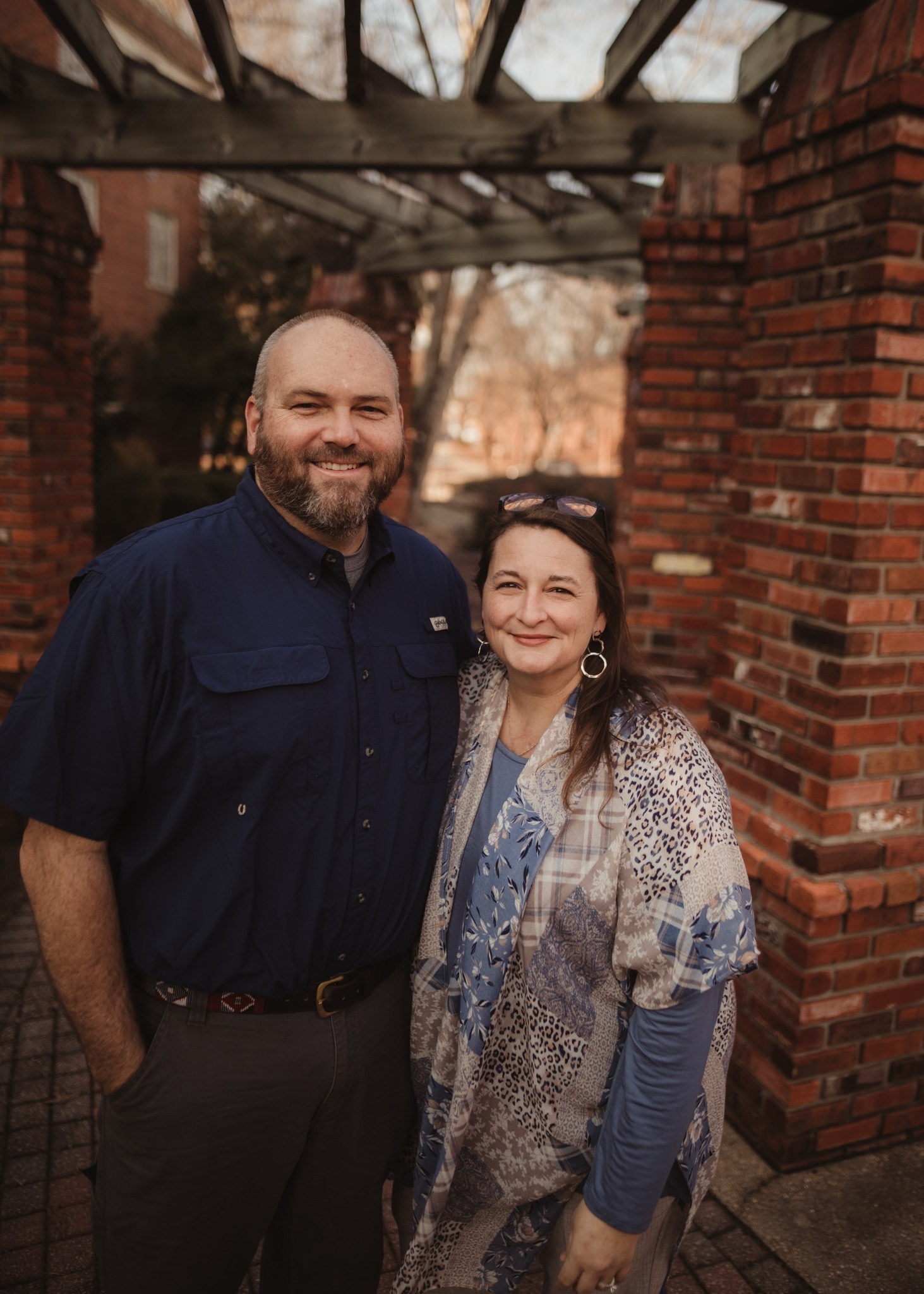
MEET THE FOUNDER & CEO
Built by a pastor, for Christian leaders. My system makes investing simple, strategic, and aligned with biblical principles.
Michael Shafer's Story:
“Facing the same financial uncertainty common among pastors, I stumbled upon a side hustle 15 years ago that revolutionized not just my finances, but my ability to serve in ministry without the looming stress of financial insecurity. This journey led me to a significant realization: financial freedom and ministry can coexist beautifully.”
But this isn't about Michael's journey...
Here are some real-life stories from others in the community

"His process works!"
“I have done this program consistently for six months now. For the eight out of the last 10 weeks, I have hit my weekly target in profit that allows me to pay a targeted portion of my bills without using my paycheck. Any Pastor should consider working with Michael because it is clear that he 100% cares about helping you make sure your financial future is more secure. There is no other agenda. And his process works!”
- Adam W., Arkansas


"I took control of my IRA"
“Using the method of investing I have learned through the program, we have been able to gain traction in our retirement programs and took control of our IRAs. I did not understand how to invest our portfolios and used mangers that cost 6%+ per year. This created a strain on our retirement during long term down periods in the market. We have gained more than the cost of the program in several days.”
- Aaron S., Oklahoma
"My account has grown 65.5%!!"
"I made my first trade with real money one year ago. I had $2400 in my account. Closing today’s trade, my account has grown 65.5%!! This year alone it has grown 31.4% in 3 months. I want to say thank you for all you have taught me. I don’t know how often you are told that you are making a difference for pastors/missionaries in the area of finances, but you are definitely helping me."
- Lew J., Kenya

"The side-hustle I've been looking for."
“This has been exactly the kind of side-hustle I was looking for. I needed someone I could trust to teach me how to get more time back and stop doing side gigs that take hours of my time and eat away at my ministry focus. Plus, I make more money with this. A double win!"
- Will D., Arkansas
These stories are individual experiences, not guarantees. Trading involves real financial risk, and many learners will experience losses as they grow. Only trade with capital you can afford to lose.
Choose Your Best Next Step
A. Just Exploring?
B. Brand New to Investing?
C. Ready to See Trades In Real Time?
IMPORTANT RISK DISCLOSURE
Trading and investing involve substantial risk and are not suitable for all individuals. Past performance is not indicative of future results, and no trading strategy, system, or approach can guarantee profits or protect against losses in all market conditions.
Stocks for Pastors and its instructors provide educational content only. We do not provide personalized investment, legal, or tax advice, and we do not make recommendations tailored to any individual’s financial situation. All examples, trade structures, and performance discussions are for educational and illustrative purposes.
Options trading, including spreads, involves defined risk but can still result in the loss of capital. Futures, options on futures, and securities trading carry a high level of risk and should only be undertaken with funds you can afford to lose. You are solely responsible for understanding the risks involved and for all trading decisions you make.
While we strive to present accurate and timely information, Stocks for Pastors makes no guarantees regarding the completeness or accuracy of data, pricing, or market information, which may change without notice. Errors, omissions, or delays may occur due to market conditions or third-party data sources.
All content reflects the opinions of the presenter at the time of publication and may change as market conditions evolve. Nothing presented should be interpreted as a solicitation, recommendation, or endorsement of any specific security or trading strategy.
Trading requires discipline, emotional control, and sound judgment. Even well-structured systems can experience drawdowns and periods of underperformance. Losses are a normal part of trading, and results will vary from trader to trader.
By participating in Stocks for Pastors content, programs, or events, you acknowledge and accept these risks and agree that you are responsible for your own financial decisions.


© 2025 G6 Allies - All Rights Reserved


