
Learn Short-Term Investing From a Pastor, With a Plan That Honors Your Faith
A guided options income plan for Christians who want steady, realistic income growth—without gambling, hype, or endless screen time.

Trusted by pastors, missionaries, and church leaders worldwide
If You Love Jesus and Also Want More Income… You’re Not Crazy
You’ve given your life to ministry and serving others. You live modestly. You trust God to provide. But you also feel the weight of retirement, college, and future expenses, and you wonder if learning short‑term investing is wise, or if it will pull your heart in the wrong direction.
This is probably for you if...
You’ve dabbled in investing or trading but never found a plan you trust.
Some months you’re up, then you give it all back, and your balance trends sideways or down.
You want more income, but not at the cost of your peace, your integrity, or your calling.
A Guided Income Plan Built on Biblical Wisdom, Designed for Steady Income
This membership helps faith‑driven traders pursue consistent monthly income over time by combining four biblical guardrails, a simple market lens, defined‑risk options spreads, and a fixed‑ratio compounding plan.
Faith-Based Guardrails
Four principles from Proverbs shape every decision: risk comes first, discipline is non‑negotiable, trade the long view, and never treat trading as something you can simply copy.
Defined-Risk Strategies
Every trade uses simple spread structures with a clearly defined maximum loss before you ever enter. If the risk isn’t clear, the trade doesn’t happen.
A Clear Compounding Plan
Position size grows only after realized profits justify it, using a fixed‑ratio approach that favors steady progress over emotional swings.
How the System Works
Step 1: Get the Map
Short, focused lessons give you the framework, language, and structure: faith‑based principles, VWAP market lens, risk rules, and strategy playbooks, so you’re not guessing or piecing together random strategies.

Step 2: See Real Trades
Weekly reports and trade alerts show you the exact setups, entries, and exits, with risk defined in dollars, so the map meets real trades so you can see how those principles look in real trades.

Step 3: Grow in Community
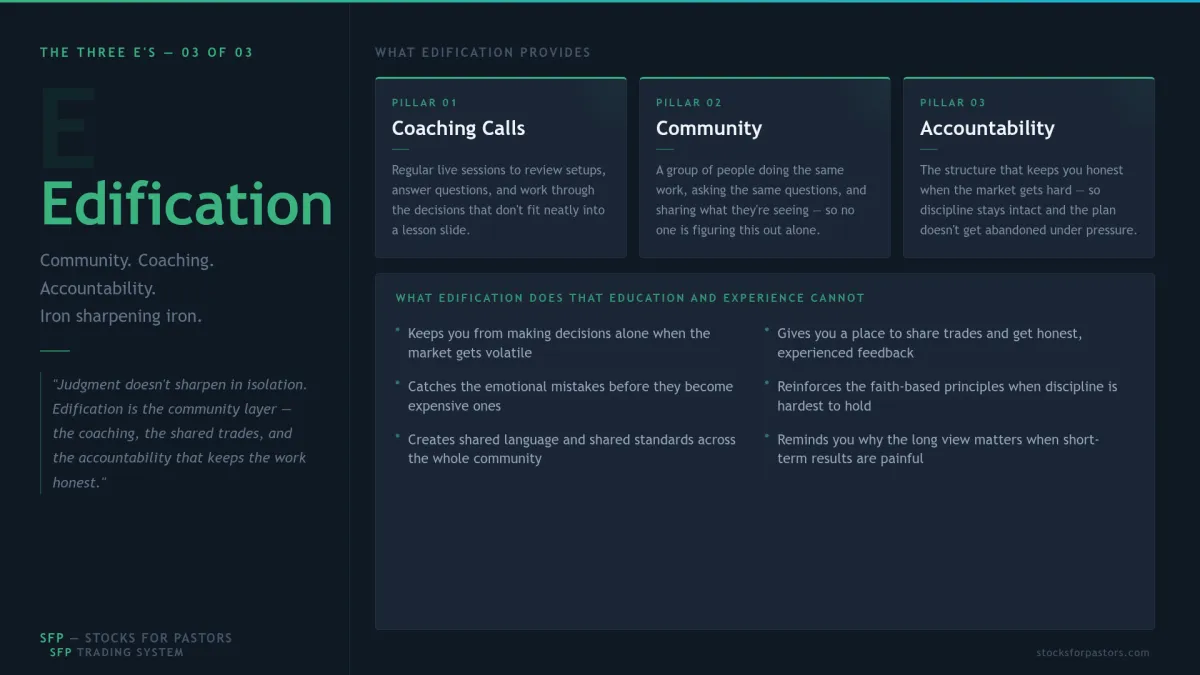
Live coaching calls and a like‑minded community help you stay disciplined, process emotions, and keep your trading aligned with your faith so discipline and peace can grow alongside your skill.
Read Our Latest Blogs
Lorem ipsum dolor sit amet, consectetur adipiscing elit.

Under the Broom Tree: What Elijah's body needed before his soul could heal
God shows up in unexpected places. Sometimes it's a broom tree, or the retelling of what happened to a prophet under one. This is a hard subject to talk about, but it's a necessary one.
I've heard Elijah talked about most of my life. He was the mighty prophet who did astonishing things on center stage for God. A “fire-and-rain” prophet to his core, a performer of God's power. But really, he’s just a man God chose to use. And despite the highlight reel, I think it was hard. He got tired. He wanted to run, and sometimes he wanted out entirely.
I've heard his broom tree moment chuckled at, as if he were simply tired and a little dramatic. But I've sat under that proverbial tree myself. Exhausted, without vision, feeling completely alone and out of options, with barely any cover over my head to protect me from the elements. I've begged God to end it, then drifted off to sleep, only to wake and feel the crushing disappointment of still being here. We don't talk about this enough. We should.
The truth, at the root of that dust under the tree, is that I don’t really want to die and neither did Elijah. He wanted to live differently. He wanted God to remove him from his circumstances, and honestly, so have I. If I had to guess, so have you. We bring emotional pleas to God, not logical ones. And God hears them anyway.
Ministered to First in the Body
Elijah was struggling theologically, but God didn't address that first. He ministered to Elijah's body. The creator knows how he made us. He knows what we need most in our most desperate moments. The rhythm went like this: sleep, eat, sleep, eat, walk, silence, sleep, then theological reckoning.
God knows us holistically: body, mind, spirit, and circumstance all at once. However dramatic it sounds, sometimes when we’re so tired we feel like we can’t press on, when all we can manage is begging God for an escape, the most theological thing we can do is take a nap.
Eating for Strength, Not for Comfort
God sends an angel to wake Elijah and tell him to eat and drink. What's interesting and very against our modern instincts is that he was told to eat specifically for strength. He wasn't eating his feelings. He ate because without food, he'd have no strength for what was ahead. Our bodies need sustenance, not chocolate cake because we're sad. That doesn't mean a treat now and then is wrong, but I do want us to see the full picture of what God is doing here, in its own context, rather than filtered through our modern comfort culture instincts.
God doesn't skip the theology. The confrontation at Horeb is still coming, and it isn't soft. But God refuses to have that conversation with a man whose body can't yet hear it well. The care isn't a substitute for the truth, it's what gives the truth the ability to land.
The Long Walk
Once Elijah's body is rested and fed, he sets out on a long walk. I don't think that's incidental. I think it's included on purpose. God is preparing Elijah to hear what's coming, and to respond in obedience when it does. The mercy of God is on full display here: he designed us to move forward from hardship, and if God doesn't skip that created, physiological process, neither should we.
Movement does more than "burn off" agitation. It's one of the most direct ways the body discharges a stress response instead of just distracting from it.
When you're under threat, real or perceived, your body prepares to run or fight. Cortisol and adrenaline rise, muscles tense, your heart rate climbs. In modern life, and in Elijah's, the danger passes but the body doesn't always know how to stand down. That activation has nowhere to go. Walking gives it somewhere to go. The rhythmic, bilateral motion tells the nervous system the threat has passed and it's safe to come down out of high alert. Even short walks have been shown to shift a person measurably out of fight or flight.
Steady movement lowers cortisol rather than simply distracting from its effects. It helps regulate the very system burnout dysregulates, making the body less reactive over time. This is a very different response than scrolling or numbing our way through the ache. One that treats the cause instead of muting the symptom.
Walking changes brain chemistry directly. It triggers endorphins, along with serotonin and dopamine, the neurotransmitters most tied to mood stability and motivation. Sustained walking has even been linked to growth in the hippocampus, the brain region tied to memory and emotional regulation. This is, not coincidentally, one of the regions most affected by chronic stress.
And it does all of this without adding a new burden. This is important to realize for someone already depleted. Gentle, sustained movement regulates the system, while intense exertion on an already-taxed body can add stress rather than relieve it. Elijah's forty days isn't a boot camp. It's the slow, sustained kind of movement that recalibrates rather than depletes.
By the time Elijah reaches Horeb, his body has been given what it needs to receive a hard truth. He's rested, fed, and the pent-up weight of "I alone am left" has had forty days to move through him before God ever asks him to say it out loud again, this time with reason instead of raw emotion. The wilderness walk isn't empty time before the real encounter. It's part of how the encounter becomes possible.
Why Horeb, of All Places
It isn't clear in the text whether Elijah was told to go to Horeb, but it's likely he's returning to the one place he believed God's presence would be. Horeb and Sinai are the same mountain. Exodus and Numbers tend to call it Sinai, while Deuteronomy and 1 Kings call it Horeb. For both Moses and Elijah, it's known as "the mountain of God." The history there is bold, and it's likely why Elijah chooses it now. He is desperate to see God intervene.
The text draws a sharp, intentional contrast between Elijah and Moses. Sinai originally came with wind, fire, and a shaking mountain. This is appropriate for the giving of the covenant. That's where the original terms were cut. But at Horeb, for Elijah, God pointedly is not in any of those things, even as they echo the original scene. It’s as if it all says: that was then, and I'm still here, just not where you're used to looking for me. For a burned out prophet convinced God's action always looks the way it used to, that's a specific, aimed correction.
Then he said, “Go out and stand on the mountain in the Lord’s presence.” At that moment the Lord passed by. A great and mighty wind was tearing at the mountain and was shattering cliffs before the Lord, but the Lord was not in the wind. After the wind there was an earthquake, but the Lord was not in the earthquake.
After the earthquake there was a fire, but the Lord was not in the fire. And after the fire there was a voice, a soft whisper. When Elijah heard it, he wrapped his face in his mantle and went out and stood at the entrance of the cave. Suddenly a voice came to him and said, “What are you doing here, Elijah?”
The Cave, the Veil, the Threshold
God tells Elijah to go out and stand on the mountain in his presence. Elijah doesn't. He stays in the cave and endures the wind, the earthquake, and the fire from inside of it. It's the quiet, thin whisper that finally draws him to the entrance, but not without hesitation. He wraps his face, not because he's told to, but because he recognizes what's happening, and he is both reverent and afraid.
God asks him why he's there. This is not because God doesn't know, but as an invitation. It's God asking Elijah to give voice to his pain. And Elijah repeats, almost word for word, what he's already said.
God doesn't answer by lifting him out of his circumstances. Instead, he hands him a plan. Proof, over time, that he isn't alone. Rather than a felt, immediate rescue, God gives Elijah a process, one that eventually yields a friendship in Elisha.
In a culture of burnout, we tend to want comfort now and a fix we can feel in the moment. God rarely works that way. He shows up through the process itself, the slow, ordinary unfolding of a plan that asks for obedience before it ever asks for understanding. That's how we find out we were never alone to begin with.
Even after Elijah knows where God is, he doesn't burst back into the open, fearless. He comes out veiled, and he stops at the threshold. Even his response to God finally showing up is cautious, partial, reverent but still guarded. I think that might be the most emotionally honest detail in the whole account. Burnout doesn't resolve in one clean, confident step back into the open. It resolves at the doorway, face still covered, listening for what comes next.
What This Means for You and Me
Burnout is real. Depression is real. The deep, raw darkness of the broom tree happens to the best of us. The hope in that is that God is always seeing. He doesn’t look away because your face is buried in your hands begging for an escape. He ministers to us physically, mentally, and spiritually, long before he ever asks us to reckon with it theologically.
Sleep. Eat. Walk. Wait for the process to unfold and listen for God in the quietest moment you've ever known. And when God is silent, on that 40 day walk, it’s not because he left you alone, it’s because in his mercy he is allowing you the time it takes for your body to be able to heal, recover, hear and then respond. Sometimes it’s mind-bendingly hard, but we are drowning in his grace even so!
No matter what, you are not alone.


MEET THE FOUNDER & CEO
Built by a pastor, for Christian leaders. My system makes investing simple, strategic, and aligned with biblical principles.
Michael Shafer's Story:
“Facing the same financial uncertainty common among pastors, I stumbled upon a side hustle 15 years ago that revolutionized not just my finances, but my ability to serve in ministry without the looming stress of financial insecurity. This journey led me to a significant realization: financial freedom and ministry can coexist beautifully.”
But this isn't about Michael's journey...
Here are some real-life stories from others in the community

"His process works!"
“I have done this program consistently for six months now. For the eight out of the last 10 weeks, I have hit my weekly target in profit that allows me to pay a targeted portion of my bills without using my paycheck. Any Pastor should consider working with Michael because it is clear that he 100% cares about helping you make sure your financial future is more secure. There is no other agenda. And his process works!”
- Adam W., Arkansas


"I took control of my IRA"
“Using the method of investing I have learned through the program, we have been able to gain traction in our retirement programs and took control of our IRAs. I did not understand how to invest our portfolios and used mangers that cost 6%+ per year. This created a strain on our retirement during long term down periods in the market. We have gained more than the cost of the program in several days.”
- Aaron S., Oklahoma
"My account has grown 65.5%!!"
"I made my first trade with real money one year ago. I had $2400 in my account. Closing today’s trade, my account has grown 65.5%!! This year alone it has grown 31.4% in 3 months. I want to say thank you for all you have taught me. I don’t know how often you are told that you are making a difference for pastors/missionaries in the area of finances, but you are definitely helping me."
- Lew J., Kenya

"The side-hustle I've been looking for."
“This has been exactly the kind of side-hustle I was looking for. I needed someone I could trust to teach me how to get more time back and stop doing side gigs that take hours of my time and eat away at my ministry focus. Plus, I make more money with this. A double win!"
- Will D., Arkansas
These stories are individual experiences, not guarantees. Trading involves real financial risk, and many learners will experience losses as they grow. Only trade with capital you can afford to lose.
Choose Your Best Next Step
A. Just Exploring?
B. Brand New to Investing?
C. Ready to See Trades In Real Time?
IMPORTANT RISK DISCLOSURE
Trading and investing involve substantial risk and are not suitable for all individuals. Past performance is not indicative of future results, and no trading strategy, system, or approach can guarantee profits or protect against losses in all market conditions.
Stocks for Pastors and its instructors provide educational content only. We do not provide personalized investment, legal, or tax advice, and we do not make recommendations tailored to any individual’s financial situation. All examples, trade structures, and performance discussions are for educational and illustrative purposes.
Options trading, including spreads, involves defined risk but can still result in the loss of capital. Futures, options on futures, and securities trading carry a high level of risk and should only be undertaken with funds you can afford to lose. You are solely responsible for understanding the risks involved and for all trading decisions you make.
While we strive to present accurate and timely information, Stocks for Pastors makes no guarantees regarding the completeness or accuracy of data, pricing, or market information, which may change without notice. Errors, omissions, or delays may occur due to market conditions or third-party data sources.
All content reflects the opinions of the presenter at the time of publication and may change as market conditions evolve. Nothing presented should be interpreted as a solicitation, recommendation, or endorsement of any specific security or trading strategy.
Trading requires discipline, emotional control, and sound judgment. Even well-structured systems can experience drawdowns and periods of underperformance. Losses are a normal part of trading, and results will vary from trader to trader.
By participating in Stocks for Pastors content, programs, or events, you acknowledge and accept these risks and agree that you are responsible for your own financial decisions.


© 2025 G6 Allies - All Rights Reserved


