Start Investing with Confidence, Even If You’re Brand New
This free bootcamp is your first step toward confident investing. In just a few short lessons, you’ll learn a simple system you can actually use.


Most church leaders feel overwhelmed by money and unsure where to even start.
This bootcamp gives beginners a safe, step-by-step way to invest without jargon or complexity.

Imagine the peace of finally knowing how to grow your savings with confidence and consistency.

What You’ll Learn
How stocks actually work and why you don’t need Wall Street experience to invest.
How to open your first brokerage account with step-by-step instructions.
What seasonal investing is and why it gives beginners a unique edge.
A simple trading system that helps you decide when to buy and sell.
First steps for new investors so you can start with confidence, not confusion.
Why Seasonal Investing Works
Seasonal investing is built on predictable, recurring patterns in the market. Think of it like planting in the right season: some months are better for certain stocks than others. By learning these patterns, you can make informed trades that reduce guesswork and increase confidence.
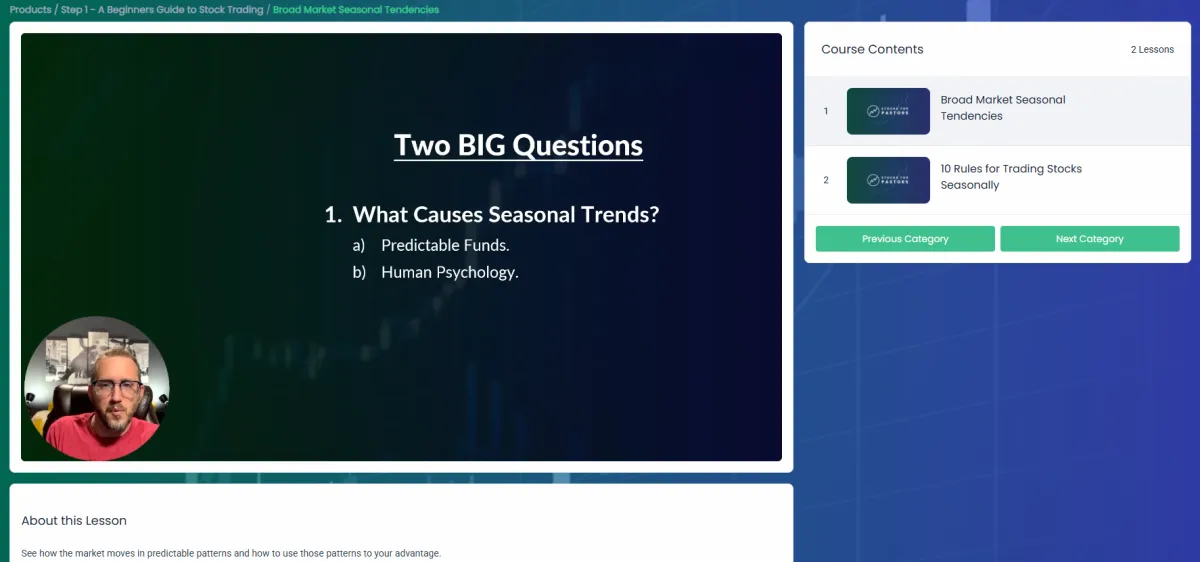
This training walks you through the process step by step, so you can take advantage of these patterns without spending hours in front of charts.
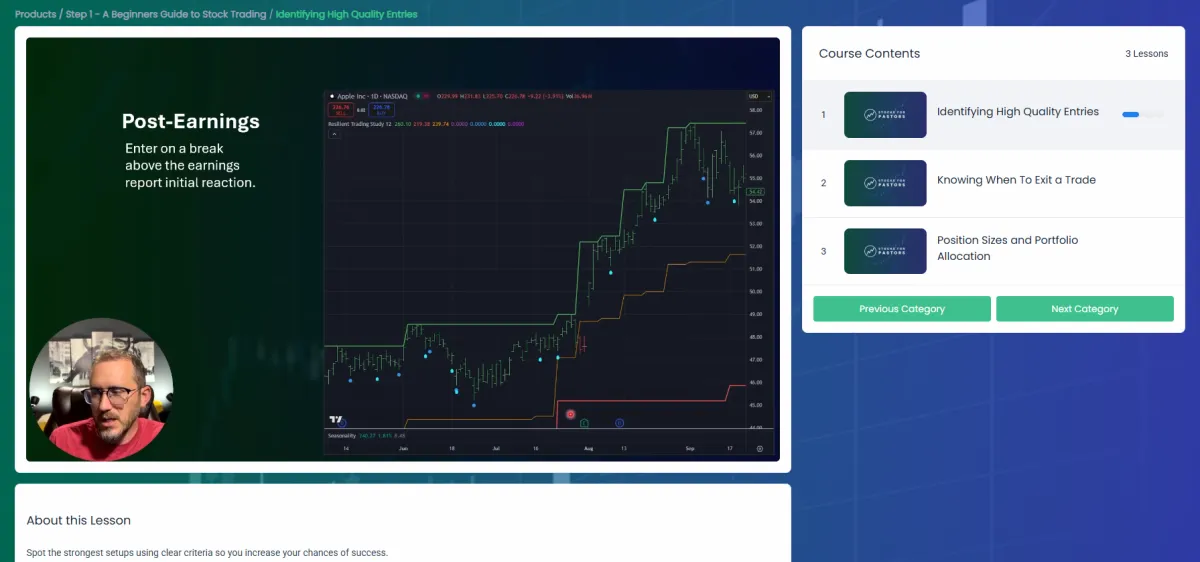
This Bootcamp was built for busy leaders who don’t want another endless online course. It’s short, focused, and designed to get you moving right away.
Who This Is For?
The First-Time Investor
You’ve never bought a stock in your life, and you want someone to walk you through the basics without making you feel dumb.The Frustrated Dabbler
You’ve bought stocks here and there, maybe even followed tips or trends, but you’ve never seen consistent results. You’re ready for a proven system that actually works over time.The Overwhelmed Saver
You’ve tried saving, but it feels slow and discouraging. You want a way to actually grow your money instead of watching it sit there.The Busy Leader
You don’t have hours each week to watch charts or read financial reports. You need a simple plan that fits into your real schedule.

I've been a pastor for over 25 years and an investing coach for more than 15. My mission is to help leaders like you build financial resilience so you can focus on your calling.
"I don’t believe in get-rich-quick schemes. This course teaches the same steady approach I’ve used for years to help leaders grow their savings without stress."
This is the system you’ll learn in the Bootcamp. I've been trading it personally for years and have teaching it to leaders like you since 2018.

Average 2–3% ROI per month for the past 7 years

Turned $1,000 into $5,000 in 2 years using this exact system

Repeatable trades built on seasonal patterns with a high win rate
Here’s what other leaders who started right where you are Have to Say about their experience with Stocks for Pastors.

“I never thought investing was something I could do, but this gave me confidence, clarity, and a clear path forward.”
Joel S.
“My account has nearly doubled in 18 months since I started with Stocks for Pastors.”
Eric B.
“Michael’s course has helped me see a clear path to advance my family financially. It is doable and attainable- exactly like he said it would be."
Dave C.
Everything You Need, Right Here
This Bootcamp is not a teaser or a sales pitch. It’s a complete, beginner-friendly system you can use to start investing with confidence. You don’t need to buy anything else to make this work.
In just a few short trainings, you’ll know how to open your account, spot seasonal opportunities, and place your first trade with a proven process.
No fluff. No missing pieces. Just a clear path you can follow starting today.


© 2025 G6 Allies - All Rights Reserved


Read Our Latest Blogs
Lorem ipsum dolor sit amet, consectetur adipiscing elit.

Two Weights, One Body
The "TMI" and "NMI" Crowds in Church Community
“Life is hard!” That’s a true statement. One that’s undeniable. We all can agree on it, and it’s perfectly fine to share. There are, however, varying degrees of heavy. Everything doesn’t weigh the same when it comes to how hard a situation ultimately is.
“I’m fine!” Also, sometimes a true statement. Other times it’s used to skirt conversation and get on with life without diving into the details of whatever’s become a thorn in our daily routine.
Do either of these statements have a bearing on our obligation to what the gospel expects of us among our church family? It may seem like an odd question, but arguably we find something in between these two concepts that has thrown our churches off kilter, thanks in large part to the cultural overuse of therapeutic language.
We all know people in circles we’d consider the “TMI” crowd. They chronically overshare, and they amp up the emotional wattage on whatever they’re experiencing in life. Almost everything they face is a “trauma,” and their use of that word serves as a linguistic intensifier rather than fitting any clinical criteria. We brace ourselves when they walk in the door, because here comes the elevated pitch, the frantic hand motions, and the drawn-out diatribe on whatever mildly uncomfortable thing they encountered since they were last seen.
Is whatever the TMI crowd dredges up and heaps in a messy pile in front of their faith family something we’re all obligated to carry as a burden? If so, how do we avoid the compassion fatigue we feel almost instantly?
What about the “not much information” crowd, the NMIs, as I like to call them? The ones who don’t want to burden anyone with what’s going on in life, or maybe they’re just too private to share the inner workings of what they’re actually experiencing. Are they the stronger hero in the family circle, or is something missing because of their limited sharing?
I think it’s between these two questions that we find the grind of the gospel working to chip away at our rough edges and make whatever our natural inclination might be look more like Christ.
Galatians 6:1-5: The Full Passage
Brothers and sisters, if someone is overtaken in any wrongdoing, you who are spiritual, restore such a person with a gentle spirit, watching out for yourselves so that you also won’t be tempted. Carry one another’s burdens; in this way you will fulfill the law of Christ. For if anyone considers himself to be something when he is nothing, he deceives himself. Let each person examine his own work, and then he can take pride in himself alone, and not compare himself with someone else. For each person will have to carry his own load.
— Galatians 6:1-5 (CSB)
Breaking Down Paul's Words in Galatians 6:1-5
There’s so much packed into these five verses. At first glance, Paul’s words almost seem to contradict themselves, but they don’t. Understanding the language he used is essential to understanding the full concept of all that’s being said here. And when we do, the expectations become so incredibly practical.
Restore: What Katartizete Means in Galatians 6:1
“If someone is overtaken in any wrongdoing.” We like to avoid this altogether, because no one wants to have the hard conversations that flow out from this. We’ve become a church that’s interested in the wellbeing of the physical body and the mental health status, but one who cares very little about the wellbeing of the soul.
You can take a deep breath, because what I’m about to tell you paints the care of someone’s soul in a much softer light than our English-speaking minds comprehend. Paul tells us to “restore” those who have been overtaken by wrong. The word he used in Greek is katartizete, which is used elsewhere for mending torn nets or setting broken bones. It literally means restore, but we tend to process it as an act of correction. The two are not the same. Paul is saying to gently set back in place that which has been misaligned. A broken bone reset so proper function can return, or a net mended so a fisherman can catch the maximum number of fish. Why would we let someone walk on a broken leg if we were capable of gently restoring their bone to proper function? We wouldn’t. So why allow the same for someone’s spiritual brokenness?
I’m often asked, “But how can I correct someone else when I’ve made the same mistakes in the past?” Paul answers that too, with a warning: “watch out for yourselves.” No one who’s offering restoration is to view themselves as above the fall. None of us has ever met the standard for restoration. Only Jesus is capable of that. In many places along the way, we’ve tripped up, and someone has offered us restoration. Why would we not do the same? It’s all to be done with caution, because not one of us will ever be above the fall on this side of heaven. There’s no room for pride in this system, and no room to refuse restoration to someone else, however awkward we may feel going about it.
Carry One Another's Burdens: The Meaning of Baros in Galatians 6:2
And then we get to the famous instruction to “carry one another’s burdens.” But what exactly does that mean? Paul uses the word baros, understood as a heavy or crushing weight. A weight so dense no one could bear up under it alone. That’s the qualifier for what we’re asked to pick up on behalf of others in our faith family. And the pride warning that follows is aimed at both crowds: TMI and NMI alike. Pride is the reason we choose not to bear a burden for someone else, and it’s the reason we refuse to hand ours over for help. I hear both sides of it often, from “I’m just a private person and don’t like anyone knowing my personal details” to “I have zero sympathy for what someone else is going through; my life is hard enough on its own.” Both lines of thinking are saturated in pride, and both shy away from what Scripture requires of us.
Carry Your Own Load: What Phortion Means in Galatians 6:5
In verses 4-5, Paul makes a shift that, if we’re not paying close attention, looks like a contradiction. He’s just told us to bear one another’s burdens using baros. Now he instructs us to carry our own load, but the word here is phortion, meaning an everyday weight meant for one person to carry, like a traveling pack. It’s not crushing; it’s just yours. Test your own work, Paul says, and don’t measure yourself against someone else’s, because in the end each of us is accountable for our own portion. The vocabulary shift is the key to the whole passage: community bears the crushing weight together, but ordinary personal responsibility, your own work, your own walk, stays yours to carry. Paul isn’t contradicting himself. He’s drawing the line between what community should never let a person carry alone, and what no community can carry for you.
Three Instructions From Galatians 6:1-5 for the Church
Understanding this passage is vitally important, and the urgency should be expedited in our modern culture. We’re given three distinct instructions: Restore those around us who’ve fallen into wrongdoing. A soul is of the utmost importance, but do that work with caution, because not one of us is above the fall. As a community, bear life’s crushing weight with one another; don’t be too prideful to do this, whether the burden is yours or someone else’s. And carry what’s actually yours — because you alone will answer to God for your own life.
That's Not a Burden. That's a Body.
None of us gets to opt out of these three instructions by hiding behind a label like TMI or NMI. The gospel doesn’t ask us to diagnose which crowd someone falls into before deciding whether their weight is legitimate. It asks for the katartizete kind of gentleness, the baros kind of solidarity, and the phortion kind of quiet, personal faithfulness. And it asks us to show up for all three, even when it’s inconvenient, even when we’ve stumbled before, even when someone hands us more at the door than we bargained for. That’s the whole of it: gentle enough to restore, strong enough to carry weight together, faithful enough to shoulder what’s ours.
That’s not a burden. That’s a body.
